Transfer times and why they matter

Some KiwiSaver providers are taking longer than they ought to carry out a requested transfer to another scheme.

SOURCE OF DATA

Speed and a lack of friction costs are essential for an efficient market. Since its inception in 2010 (two years after KiwiSaver was launched) the number of members in the NZ Funds KiwiSaver Scheme has grown year on year for nine years.

As our scheme has never sought default status and never acquired another scheme, the growth has been entirely organic. New members have primarily joined by switching from other providers. 

In total, NZ Funds has attracted 6,880 members and lost 1,520 members – small in comparison to default funds – but big enough to gather information on over 1,000 switches to the NZ Funds KiwiSaver Scheme in the last 30 months.

After scrubbing this data for errors, outliers and PIE tax rebates, we discovered the KiwiSaver industry can be divided into two types of managers: efficient operators, and those who appear to be gaming the system.

THE EFFICIENT OPERATORS

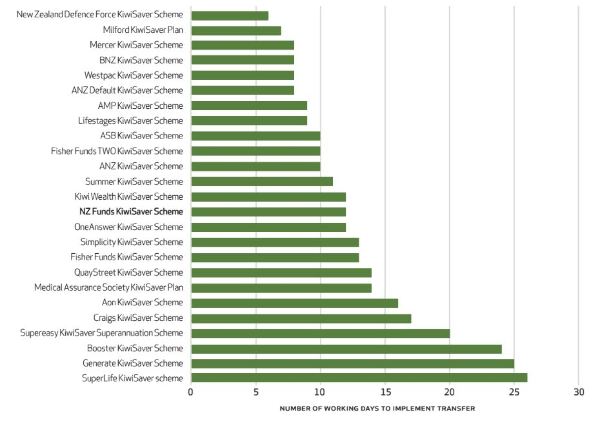
Despite being criticised by the FMA in 2014 for poor sales practices, when it comes to assisting members who have chosen to transfer to another provider, Australian owned banks Westpac, BNZ, ANZ and ASB completed their transfers in less than 10 days on average. 

Similarly, AMP and Mercer took less than 10 days to action members’ switch requests from their schemes to the NZ Funds KiwiSaver Scheme.

But the industry leader, by our numbers, was Milford with a sharp turnaround of just seven days for its members. A bouquet should also go to the New Zealand Defence Force KiwiSaver Scheme. They managed to implement the transfer of the one client that came across to the NZ Funds KiwiSaver Scheme within six days.

For the record, NZ Funds currently takes an average of 12 working days when transferring members out of its scheme, which is something we could improve on. The average for the industry as a whole is 11 days.

THE MARKET GAMERS 

And then there are those which needed or chose to take 20 days or more to complete the same process, like SuperLife which ranked last in actioning transfers to the NZ Funds KiwiSaver Scheme by taking an average of 26 days to switch members who had asked to transfer. They were joined by Generate which took 25 days, and Booster which took 24 days.

Excluding SuperEasy, a restricted KiwiSaver scheme for local council employees, there are no other managers who take on average 20 or more days.
The different treatment of transfer requests from default schemes and non-default schemes also makes for interesting reading. 

Under the existing rules, default schemes are required to process transfers within 10 days, while non-default scheme providers can take up to 35 days. It is interesting to observe that Booster, which has both default and non-default schemes, appears to be able to comply with the 10 day requirement for transfers from its default scheme, but is not able to do so for transfers from its non-default scheme. 

Who benefits, who loses and what are the rules? The benefit of delaying a transfer are clear. This aspect of KiwiSaver is now widely recognised as being poorly conceived.

As part of the amended Scheme Provider Agreements, all schemes will be required to transfer within 10 working days from April 1, 2020. This is a positive move, but it is a pity that some schemes did not self-regulate themselves to ensure they were acting in all members (including exiting members) best interests. 


Michael Lang is Chief Executive at NZ Funds and his comments are of a general nature. New Zealand Funds Management Limited is the issuer of the NZ Funds KiwiSaver Scheme. A copy of the latest Product Disclosure Statement for the scheme is available on request and at www.nzfunds.co.nz.

Young people should budget to live to 100, actuaries say

New Zealanders are getting information about how to build wealth, but not how to spend it, a group of actuaries says.

The Retirement Income Interest Group of the New Zealand Society of Actuaries made a submission to the 2019 Review of Retirement Income Policies.

They pointed out that longevity was increasing but New Zealanders were being given insufficient information about how to make their money last.

"Guidance for New Zealanders is better for accumulation than for the decumulation phase."

They said it would be sensible for younger people, especially women, to plan for a retirement that lasted until they were 100.

The group said people should be given KiwiSaver statement wording and underlying projection models that were updated regularly to reflect the latest longevity data, encouraged to consider their decumulation options through to age 90, 95 or 100, and regulations should be introduced for KiwiSaver projections to explain different drawdown strategies and their consequences.

From next year, KiwiSaver providers will have to give annual statements including projections of what their income might look like in retirement. 

"Compared with the accumulation phase (where it is usually agreed that any saving is better than none), decumulation is harder to generalise and there are more risks involved," the group said.

"People have limited resources in later life, especially once they have finished working, so it is hard to recover from a mistake or bad luck.

"Longevity risk can be dealt with by buying an annuity product, but the New Zealand market is currently limited to one product which will not be right for everyone."

Alison O'Connell, lead author of the report that accompanied the submission, said it was unlikely that providing for retirement could be left in the hands of private savings – even for the youngest New Zealanders.

She said New Zealand Superannuation was the best protection against longevity risk.

"It is quite possible that, despite the introduction of KiwiSaver, younger cohorts will need NZS just as much, if not more, than older cohorts, because of lower home ownership, lower wage growth, less stable jobs and lower savings rates.”

She said it would be a policy choice to keep the pension age at 65 – and it was not unaffordable for the country.

The group suggested, if there were to be a change, the age was lifted to a level where future generations could expect to have the same number of years on the pension as earlier generations.

“Even with an eligibility age of 68 years, today's 25-year-olds would be expected to receive NZS for longer than the cohort aged 85 who had an eligibility age of 60 years.”

Nikko attracts big balances

Nikko’s new KiwiSaver scheme is attracting savers with large balances, rather than large numbers of savers.

The fund manager launched its robo-KiwiSaver in March.

Managing director George Carter said it had been notable that those who moved their money to Nikko tended to have more saved.

The average balance in Nikko’s KiwiSaver funds is now more than $100,000.

That’s compared to a median balance across the scheme of $13,000.

Carter said Nikko did not have a retail brand and was trying to build presence in a niche way.

It wants to reach 0.8% market share.

He said it seemed that it was attracting people who were in the industry and aware of what Nikko did. They tended to be higher-paid and more engaged with KiwiSaver than the wider public.

“Getting the message out more broadly is taking a bit of time.”

The scheme now has funds under management of $10 million across 120 members.

Carter said it was an interesting part of the market to be in and required Nikko to communicate in a different way to capture the retail and consumer segment. Traditionally it had only dealt with institutional investors, which had meant a different approach, he said.

It offers a tool that allows users to do long-term or short-term financial planning.

They can set and manage investment goals in their online account, including KiwiSaver but also covering things such as saving for a holiday, new car, or accumulating an emergency savings account.

They then ask the tool to recommend funds that will help them achieve that, based on their risk profile, and can then set the investment up online via a "set up investment" button.


Life stages research shows big differences in outcomes

Lifestages funds are a better option for savers than default KiwiSaver funds, but they’re not all created equal, new research from MyFiduciary suggests.

The research was commissioned by NZ Funds and reviewed the lifestages options available in New Zealand.

Nine out of 22 KiwiSaver managers offer a lifestages option. These reduce the level of risk an investor is exposed to over time.

David Rae, an investment consultant and principal at MyFiduciary said the research found that the average fund was too conservative overall and started de-risking too early.

There are two main approaches to lifestages investment – one makes small regular changes to asset allocation while the other undertakes less frequent but bigger steps. AMP, ANZ, Generate and Lifestages opt for the latter.

Bigger steps could be a problem if rebalancing coincided with a bad time for the equity market. Rae said a smoother approach was much better.

But he said in general any lifestages approach was better than a single setting for an investor’s overall outcome.

“The right investment allocation for a 25 year old is very different o a 65 year old … you’ve either got to be pretty active through your investing life to make sure you are getting the right setting … or you do it automatically through a lifestages approach.”

The Government has proposed requiring default KiwiSaver funds to take a lifestages approach.

Rae said this would be an improvement.

People were more likely to choose a lifestages option than to opt for a high-risk investment fund if presented with a menu of options, he said, and default funds would never be set at the 80% growth allocation that would best suit many young investors.

But they could be delivered those results through a lifestages fund.

Early de-risking remained a problem, though.

The research showed that ANZ had people in zero growth assets at 65, despite potentially having another 30 years to live.

Some started to dial down risk when investors were in their 40s, Rae said.

“In terms of total accumulation of wealth through the life cycle that’s early in dollar terms.”

MyFiduciary modelled a person who starts saving at age 25, has an income of $75,000 that grows through time, and saves 4% of their income (plus a 3% employer contribution).

The average of all balances at 65 was $426,000.

Savers who chose NZ Funds, Fisher Funds or SuperLife achieved a higher level of expected wealth at retirement after fees.