KiwiSaver’s dark web

Some KiwiSaver funds could be less liquid than they claim.

At $55 billion, KiwiSaver is about the size of a third of all shares listed on the NZX. That is big enough to hide a multitude of “assets”. Like the dark web, you need to dig deeper than the fund updates and use forensic expertise to decipher what funds hold, but if you look, this is what you will find.

Each KiwiSaver manager is required to calculate an asset liquidity ratio quarterly. The main test of whether an asset is liquid is whether it can be sold in 10 working days at close to its stated value. Illiquid assets are any investment that cannot be sold within that period and private assets, such as unlisted property or private equity.

Based on our analysis, as at March 2019 Fisher Funds TWO KiwiSaver Growth Fund was an investor in unlisted property, holding 6.62% or $27.8 million. The problem with unlisted property is that there is no arm’s length daily price at which investors can transact. Investors entering and exiting funds which hold illiquid assets are therefore not treated equally. The conventional wisdom is that this is acceptable for the greater good. 

However, at extreme points in the cycle illiquid assets can become difficult, if not impossible, to price, buy or sell.

The Fisher Funds schemes have also lent money to a private company, Tax Traders Limited. We estimate that as at the end of March they had lent more than $150 million. This debt appears to have been privately placed to one or two holders. It is difficult to determine whether they have classed this as an illiquid or liquid security. It is certainly an unusual investment.

Another holder of private assets is the Booster KiwiSaver Scheme. Booster has a number of unique aspects to their scheme. We have previously written about two of these – one of their other public funds lending $8.0 million to leverage shares in their KiwiSaver Geared Growth Fund, and their use of a creatively structured exit fee.
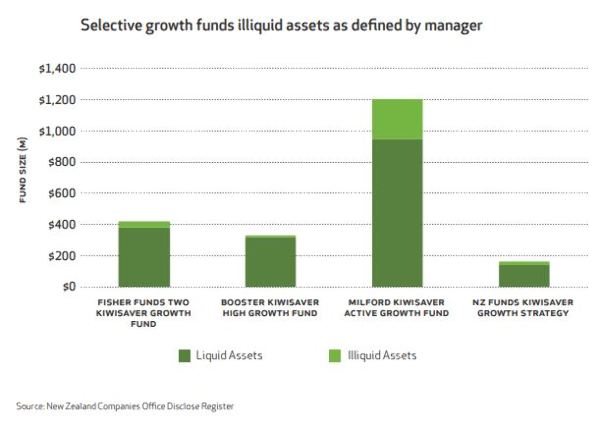
Booster lists 22 private assets in its High Growth KiwiSaver Fund. Most appear to be wine related. At least one of these assets were purchased out of receivership with funding provided in part by their KiwiSaver scheme. 

A number of these 22 private assets appear to be related entities, such as Sileni Winery Building, Sileni- Plant and Equipment and Seleni Wines Limited Partnership. This raises some interesting questions. Are these really separate investments? Can one be sold without the other or without impacting the others’ price? These are questions an adviser might like to mull over. Of equal interest is that, despite the 22 private assets summing to over 5% by our math, Booster discloses an asset liquidity ratio of 96.92% for this fund at March end.

We estimate that the Milford KiwiSaver Active Growth Fund has 2.15% of private equity holdings. This fund has the look and structure of a well-diversified portfolio of private equity holdings. If KiwiSaver schemes are going to invest into private equity, then in our view Milford’s approach is a good example of how it should be done.

Those who live in glass houses should not throw stones, so the report is not complete without disclosing NZ Funds’ own illiquid holdings which in the case of the NZ Funds KiwiSaver Growth Strategy, sum to 13.53%. Our holdings are in hedge funds which have notice periods to exit, and are therefore treated as illiquid.

However, the big difference between our investments and private assets is that our investments can be readily priced. When we invest in hedge funds, we ensure that the underlying investments are market listed securities which can be priced daily.

On a more general note, it appears as though many managers assume that if a company is listed it is liquid, only some seem to be taking daily liquidity into account. The average daily volume that some shares can be sold at without moving the share price indicates otherwise. The FMA have signalled that illiquid assets will be one of their focus areas. Their oversight will be timely.

A copy of the latest Product Disclosure Statement for the scheme is available on request and at www.nzfunds.co.nz. 
Michaels’ comments are of a general nature, and he is not responsible for any loss that any reader may suffer from following it.
FSC KiwiSaver overhaul: Boost access to advice

Financial advice could be provided free or at a discount to SuperGold cardholders, or be made tax-deductible, the Financial Services Council has suggested among its package of recommendations to overhaul KiwiSaver.

Its KiwiSaver 2050 document, released today, identifies six issues to be tackled to improve the performance of KiwiSaver over the long term.

It said participation needed to be increased, contribution levels improved, more decumulation options were needed, focus should be put on financial literacy, there should be more political stability around the scheme, and improved scheme efficiency and effectiveness.

“Each of the areas identified above are complex and there are no easy fixes or quick solutions to achieving them,” said FSC chief executive Richard Klipin.

“However, the discussion paper does propose a number of ideas for further consideration and discussion to help drive better outcomes in these areas.

“For instance, increasing participation through providing a minimum level of saving so that those who are unable to join KiwiSaver can get started in the scheme.

“Or building contribution levels by increased engagement with KiwiSaver members in default funds to move them to more appropriate funds, making conservative funds less conservative, and continuing KiwiSaver contributions when a member is on parental leave.

“The paper also proposes consideration being given to the development of an annuity market in New Zealand to aid with decumulation, and the development of a political accord and dedicated Government Ministry to ensure ongoing stability and predictability in retirement policy-making.”

The paper notes that, although more than three million New Zealanders are KiwiSaver members, 1.2 million are not making regular contributions.

It said consideration should be given to requiring employers to make a minimum contribution of, for example, 2%, when an employee could not afford to contribute.

“An alternative to this approach is to decouple member and employer contributions. This would mean that the employer would contribute regardless of whether the member is or not. The Government contribution then could be used as an incentive for members to continue to contribute. This would ensure better equity while encouraging the saving habit.”

It said there could be built-in insurance products, to help keep people saving even if they were out of work due to accident or illness.

The rules could get tougher to encourage more savings, the report suggested.

Increasing the amount a member had to contribute to get the member tax credit from the Government could boost contribution rates, and incentives could be restricted to only those who made an active fund choice.

Members could be allowed to automatically increase their contribution rates, the FSC said, and contributions should continue for those on parental leave.

Advice was also among its recommendations.

It said financial advice could be made a tax-deductible expense, which would encourage more self-employed people to pay attention to their retirement savings plan.

It also urged a focus on advice for people who were about to retire.

“It is essential that New Zealanders entering retirement get advice to help through the next 15–20 years. At a minimum, information on decumulation and the range of options should be provided with the NZS information pack.

“Further, advice could be tied into with the SuperGold card currently provided to superannuitants and either provided free or at a discount.”

Roboadvice would also help, the FSC said.

“This will require thought on how to encourage and develop a robust offering in New Zealand.”

The full report can be found here.


Which KiwiSaver funds will weather the currency war?

It’s important to understand how different KiwiSaver Schemes manage foreign currency within their international share exposure. Michael Lang explains.

Foreign currency movements have again been in the news with the United States Treasury labelling China a currency manipulator. These movements can also have an impact on clients’ KiwiSaver returns. This is dependent on how a Scheme’s manager treats the foreign currency exposure they get when purchasing international assets.

To understand how different KiwiSaver Schemes manage foreign currency within their international share exposure, we reviewed 77 KiwiSaver funds which have an international share exposure of greater than 40%. Information on these funds was sourced from their Fund Updates and their Statement of Investment Policy and Objectives (SIPO).

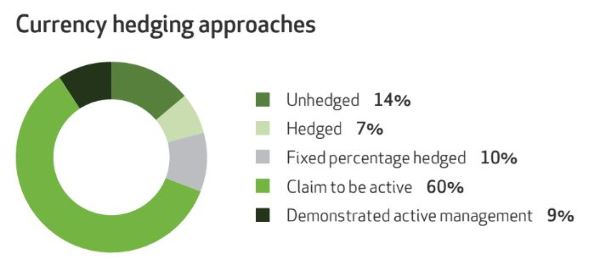
KiwiSaver Scheme managers treat foreign currency exposure in one of four ways. First, they can do nothing and when they purchase international assets, just hold those assets in foreign currency until they are sold. This is what the industry refers to as unhedged international assets.

The downside of this approach is evident. If the foreign currencies your KiwiSaver Scheme assets are denominated in collapse, so too will the value of your KiwiSaver investment. Eleven of the 77 KiwiSaver funds we reviewed followed an unhedged approach. Should the New Zealand Dollar recover, and trade at US$0.80 as it did from 2011 to 2014, these funds would underperform their peers by around 18%, all other things being equal. 

Second, a manager may choose to permanently hold your investment in New Zealand Dollars, even when investing abroad. This is done by hedging all foreign currency exposure back into New Zealand Dollars. Investors receive the return generated on the assets they hold, for example shares in Amazon or Nestle, and forego any gains or losses from currency movements.

Third, your manager may decide there is merit in a bit of both and establish a policy of hedging a fixed percentage of your foreign currency exposure. A common approach is to hedge 50% of the exposure. This is a “point of least regret” approach. The manager is never wrong, but then neither are they ever right. The fixed portion approach is currently used by eight of the 77 KiwiSaver funds reviewed.

The fourth approach is for your KiwiSaver Scheme manager to actively manage your currency exposure. This is the most popular option with 53 of the 77 KiwiSaver funds reviewed saying they follow an active currency management approach.

Whether managers are truly active or not is difficult to judge. A number of managers outline large ranges, for example 0 – 100%, within their SIPO, but when looking at Fund Updates they only seem to vary their currency exposure by 5 – 10%. Other managers outline large ranges and a target exposure, but do not disclose their foreign currency exposure in their Fund Updates, making analysis difficult.

Some managers claim to be active but utilise external fund managers that have both hedged and unhedged options and use this to manage their currency exposure. To change their exposure, they change the external fund they access. This is not the same as active currency management, as we define it. These managers are not able to take a view on a specific currency, for example, be unhedged against the British Pound but remain fully hedged against the United States Dollar.

Few managers seem to have both the skills and will to implement their views in enough size to make a difference. If a manager is successful in adding value through active currency management, they provide their clients with another source of returns, and one that is independent from share market returns. Our analysis suggests Fisher Funds, QuayStreet Asset Management and NZ Funds all fall within this category.

Being hedged, unhedged or partially hedged can have a big impact on the returns a KiwiSaver member receives from their international assets. Over the three years to 30 June 2019, the global share unhedged index returned around 13.9% p.a. compared to 11.9% p.a. from a hedged index.

Active currency management can mitigate the difference between these two indices. For example, NZ Funds added around 1.2% p.a. to the return of its KiwiSaver Growth Strategy through active currency management over the same period.

Which strategy suits you and your clients will depend on the circumstances. Demonstrating to clients your knowledge of the different styles of currency management is invaluable.


Michael Lang is Chief Executive at NZ Funds and a member of the NZ Funds KiwiSaver Scheme. New Zealand Funds Management is the issuer of the NZ Funds KiwiSaver Scheme. A copy of the latest Product Disclosure Statement for the scheme is available on request and at www.nzfunds.co.nz

Financial advisers want KiwiSaver to get SMarT

A group of four financial advice businesses wants the Government to consider implementing behavioural finance techniques to boost KiwiSaver returns.

Jonathan Parsons, of Spratt Financial, Ali Bazzaz, of One50 Group, Joseph Darby, of Milestone Direct and Clive Fernandes of National Capital are lending their support to a Victoria University report as part of a submission to the Retirement Commissioner’s 2019 review of retirement Income Policies.

They want to make it easier to implement economist Richard Thaler’s Save More Tomorrow (SMarT) plan.

It works by getting people to commit to using their future pay rises to increase their retirement savings contributions. Contributions rise each year until they reach a pre-determined maximum savings rate.

The usefulness of this approach is also being considered in Massey University research.

The report asks the Government to make changes to the KiwiSaver KS2 form to allow employees to indicate how much they want their contributions to increase each year, and to what maximum. It also asks the Government to research how the plan would work in a New Zealand context by running a trial in the public sector.

The researchers noted in their report that at the moment, employees should be able to commit to future savings increases but it would require extra administrative effort.

Fernandes said the SMarT plan had been estimated to increase annual savings in the United States by US$7.4 billion ($11.6 billion).

He said New Zealand was a few years behind some of the rest of the world in implementing behavioural finance techniques. “We will get there, it’s just a question of when. I think it would make a huge difference to KiwiSaver.”

He said it was important that employers, who would have a significant role to play in implementing the system, could see that it would benefit their employees.