Time to exit unnecessary fees

One of the things that has made KiwiSaver successful is that it is refreshingly free from the hooks and barbs of hidden charges that have traditionally bedeviled the investment industry. Or so one would hope. Unfortunately, old practices die hard.

All schemes must follow the same set of modern, competitive rules. Fees are regulated and transparent, and disclosed in a way that enables easy comparison. Right? Wrong!

In ASSET magazine’s April issue, we revealed that one KiwiSaver manager was using a publicly issued income fund to provide a related party loan in order to leverage its KiwiSaver fund. This month we raise the curtain on exit fees. 

WHAT IS AN EXIT FEE?

An exit fee or redemption fee is a charge imposed on an investor who wants to switch KiwiSaver schemes. In the old unit trusts’ world this was called a back-end loaded fund. Regardless of the terminology, the effect of an exit fee is that it reduces the value of your KiwiSaver if you wish to withdraw or switch.

WHO RECEIVES THE EXIT FEES?

Exit fees come in different shapes and sizes. They can be paid to the scheme to compensate the remaining members for the transaction costs incurred in funding the member’s withdrawal. So long as these charges are disclosed before an investor enters the fund, they are usually in line with investors’ sense of fairness. This is the case with the Nikko AM KiwiSaver Scheme that charges a modest entry and exit spread. 

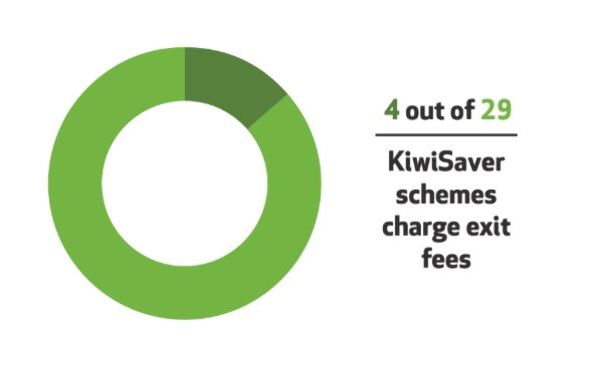
Unfortunately, this is not the case in all KiwiSaver schemes. Of the four KiwiSaver schemes that have chosen to charge exit fees, three of the scheme managers or administrators pocket the fee instead of paying it back into the fund. As KiwiSaver members already pay an annual member fee (deducted monthly) to cover the cost of administering their account, it is difficult to understand what the justification for the fee is.

ARE EXIT FEES DISCLOSED? 

Exit fees are not taken into account by Sorted when ranking KiwiSaver schemes by cost on its KiwiSaver Fund Finder or in its KiwiSaver fees calculator.

A scheme’s Product Disclosure Statement (PDS) is the defining legal document for a scheme and must set out all fees and charges. Those managers who choose to charge an exit fee must disclose it here.

However, even within the PDS, the regulatory required section “Example of how fees apply to an investor” focuses on the costs incurred on entering and being a member of the scheme. Nowhere in the PDS is there an example of the costs associated with exiting the scheme.

WHO CHARGES EXIT FEES, BROKERAGE AND SPREADS?

The Aon KiwiSaver Scheme charges $35.00 to transfer to another scheme, while the Booster KiwiSaver Scheme charges $30.00 to close a non-default KiwiSaver account, which occurs whenever you transfer to another scheme.

The Craigs KiwiSaver Scheme charges up to 1.25% brokerage on both exit and entry, in addition to its 1.25% management fee. The Nikko AM KiwiSaver Scheme charges entry and exit spreads but, as discussed, these amounts are paid back to the scheme. To the best of NZ Funds’ knowledge, no other schemes charge these one-off fees.

Interestingly, there are no exit fees in default schemes. However, the current regulatory regime allows the same manager to impose exit fees on its non-default KiwiSaver Scheme members.
HOW TO AVOID PAYING EXIT FEES

The easiest way to avoid paying exit fees is to not invest in a scheme which charges them. Simply ask your adviser what the costs are of transferring to another scheme. You will find that most KiwiSaver schemes have no additional costs.

Alternatively, if you are a DIY investor, the PDS is the best place to go. 

THE VERDICT ON EXIT FEES

Exit fees may appear small in isolation, at around $30.00 per scheme transfer, however they are just another fee investors need to worry about. In the year ended March 2018, 117,274 KiwiSaver members transferred from one active scheme to another. This has the potential of adding an
unnecessary friction cost of $3.5 million a year to a concept that is otherwise doing wonders for New Zealanders.

NZ Funds KiwiSaver Scheme is designed for use by AFAs and RFAs and charges neither an entry fee nor an exit fee. NZ Funds pays advisers both planning incentives and an ongoing commission for advice. 96% of NZ Funds’ KiwiSaver members have a financial adviser. The average balance of members of the Scheme is $27,194 (approximately one and a half times the national average of $17,834).
Pathfinder-backed KiwiSaver to target gender diversity

A new KiwiSaver scheme launching today will only invest in New Zealand listed companies that have at least one female director on their boards.

The scheme – CareSaver – has also committed to share 20% of its investment management fees from its funds with a range of leading charities including the Mental Health Foundation, Forest & Bird and Plunket, with the beneficiary charity selected by the individual KiwiSaver member.

CareSaver is established by Pathfinder Asset Management.

CareSaver will meet the investment and risk objectives of a broad sweep of New Zealand investors through the CareSaver Growth Fund, the CareSaver Balanced Fund and the CareSaver Conservative Fund.

Pathfinder’s Chief Executive John Berry says: “A diversity of perspectives is critical to effective governance. While diversity is broader than gender, those New Zealand listed companies that do not have female directors do not meet our bottom-line diversity criteria. This is not tokenism. All listed company directors must be appointed on merit, however we believe boards without diversity of perspectives are more likely to have blind spots when assessing key long-term business risks.

“Boards must choose the most qualified for a governance role, but unless New Zealand listed companies can demonstrate a commitment to address the absence of women at the boardroom table, they will be excluded as a potential investment for CareSaver. New Zealand is an outlier compared to the UK, US and Australia, and we’d like boards to explain why."

He said CareSaver aspired to be New Zealand’s most ethical KiwiSaver. Ultimately, it enables Kiwis to save for their retirement in a way that’s consistent with their values. At the same time, in line with this investment philosophy, it facilitates positive change for our communities by providing a source of long-term and sustainable funding for leading charities.

Berry said companies that scored high on a broad range of research-based ESG measures were more likely to provide better long-term returns for savers and better outcomes for our planet and its people. For this reason, representation of women in boardrooms of New Zealand listed companies is a focus.


UK Pension Transfer Service Insight

NZ Funds’ new UK Pension Transfer Service aims to become market leader

A market in need of a fresh approach

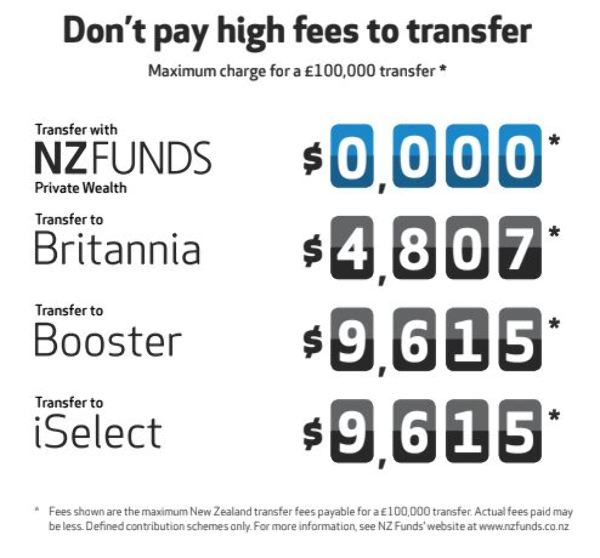
For many years, the United Kingdom pension transfer market has been a murky backwater, with little transparency or regulatory oversight. Transfers to a number of prominent incumbent providers can involve fees of up to 5% of the value of an immigrant’s entire accumulated pension. Digging still deeper, many incumbent  providers also include a markup on currency transfer rates (with the difference being kept by the provider), and charge additional fees when clients wish to withdraw their money or transfer to a new scheme. Add to that the fact that many existing schemes are old with high ongoing fees and difficult transfer rules, and you have an industry ripe for a shake up.

Don’t be fooled by the ‘free assessment’

Many incumbent providers lure clients in with offers of a ‘free assessment’. A free assessment offers little or nothing of value but is often mistaken as an offer of free advice, or better still, free transfer, which it is not. Another claim is a transfer success rate of 99% or 100% – not surprising really, when the free assessment will easily identify those UK pensions that cannot be transferred. There is no grey zone. The skills of the transferee cannot influence the outcome, as is the case when receiving immigration advice for example.

Clients who are unaware of these nuances continue to be lured into United Kingdom pension transfers at extremely high prices. 

NZ Funds business model: Free transfer & competitive management fees

NZ Funds is a privately owned wealth management firm, founded to run Lion Nathan’s pension scheme in 1988. It has a 30-year track record of managing New Zealanders’ wealth in various forms including superannuation, KiwiSaver and managed funds for retirement.

NZ Funds entered the UK Pension transfer market with a simple proposition. Using its in-house management team and nationwide network of offices, NZ Funds offers a free UK Pension transfer service, subject to the type of pension being transferred. Defined contribution pensions can be transferred for free, while the more complicated defined benefit pensions may incur UK advice costs due to UK regulation.

Clients have a choice of keeping all or part of their investment exposed to pounds sterling, and all clients receive wholesale exchange rates with no markup going to NZ Funds. NZ Funds does not charge exit fees on any of its funds, so if clients wish to move to another scheme they are free to do so, so long as they transfer to another registered superannuation scheme approved to take UK pension money.

NZ Funds overwhelmed by demand for its new service

Since entering the market NZ Funds’ QROPS-registered Managed Superannuation Service has snowballed in size to over $30 million. Ellie Jarvis, who joined NZ Funds from EY in 2018 as a UK immigrant and expert in United Kingdom high net worth tax, heads NZ Funds UK Pension transfer team. The team receives, on average, one or two new transfer enquiries a day with transfer values ranging between $5,000 and close to $5 million and have a further transfer pipeline of over $20 million work in progress.

They regularly receive referrals from accountants, lawyers and tax specialists throughout New Zealand, helping them to transfer their clients’ pensions within the four-year tax-free window New Zealand’s Inland Revenue Department offers new immigrants.

If you would like NZ Funds to review your situation please do not hesitate to contact Ellie Jarvis:
T. 09 918 9784
M. 022 061 1033
E. ellie.jarvis@nzfunds.co.nz

Ellie’s advice is of a general nature, and she is not responsible for any loss that any reader may suffer from following it. A copy of Ellie’s disclosure statement is available on request, free of charge.

Retirement policy: Call to start over

New Zealand is spending billions of dollars on KiwiSaver with no clear indication that it is leaving anyone better off, two retirement policy commentators say.

Michael Chamberlain, an Auckland actuary and investment adviser, and Michael Littlewood, co-founder of the University of Auckland’s Retirement policy and Research Centre, have released a new report, outlining “133 questions New Zealand needs answered” about retirement policy.

It follows their 2016 report, which criticised the Retirement Commmissioner's review, calling it an "evidence-free zone".

Chamberlain said little had changed, and New Zealand still lacked basic evidence to inform retirement policy.

He and Littlewood argued that greater economic growth needed to be kept central to discussion of every aspect of public policy, including retirement income.

There needed to be a longitudinal study of households, they said, to find out what they were doing with their financial lives.

Chamberlain and Littlewood said KiwiSaver was the answer to a problem New Zealand did not have.

“New Zealand has spent over $10 billion on KiwiSaver in subsidies and we don’t know if it’s good, bad or indifferent,” Chamberlain said.

He said the indications were that KiwiSaver had not improved New Zealand’s overall savings level.

“We know in Australia compulsory super hasn’t increased the overall level so there shouldn’t be surprise about that outcome in New Zealand.

"Given the predictable reduction of occupational superannuation schemes at KiwiSaver’s hands, some may even be saving less in total than previously, but we don’t know."

He said there were a number of financial advisers who argued KiwiSaver should be made compulsory but there was no evidence anywhere in the world that it worked.

A decision should be made as a country on the future of KiwiSaver, he said. Chamberlain said he was in favour of removing the lock-in aspect of the scheme and the incentives involved from Government.

More than 20 per cent of member balances could be attributed to taxpayer subsidies, Chamberlain and Littlewood said.

"Where is the evidence that these large sums have actually changed New Zealanders’ overall financial behaviour?Citing the number of members or the amount now invested in KiwiSaver doesn’t answer that question. Encouraging those numbers to grow won’t answer it either. Asking New Zealanders whether they think KiwiSaver is a good idea or whether they think they should be saving more is even less helpful."

Chamberlain said governments also had to stop making ad hoc decisions about superannuation and the age it was offered, without evidence about what the outcome of the decision would be.

“We shouldn’t simply change the age because someone thinks we should to make it more affordable. If we change the age, are we more likely to achieve its purpose?”

The pair also said moves to improve disclosure and communication with investors had not been a success.

"Knowing what financial service providers are actually doing and how financial products might suit consumers should be at the heart of regulatory supervision. New Zealand has tried to fix this, but we need to return to the beginning."

They said the new, shorter PDS documents required under the Financial Markets Conduct Act were still not being read.

"Even if read, it is highly unlikely that an investor can gain a complete picture of the investment on offer and the true risks they will be exposed to. One goal of the new regime was to make it easier to compare products and, to an extent, it achieves that. It is easier to compare fees and some features, such as contributions, withdrawal provisions etc. However, it does not make it easy to understand investment strategy and philosophy, except at a high level and in some cases, not even at a high level."

They also said the "risk indicator" measure was unhelpful – a view shared by some fund managers.

"It uses investment returns, to calculate the risk indicator, that are different from those advised to savers in their fund updates," Chamberlain and Littlewood said.

"Finally, it is based solely on recent historical volatility and is unrelated to the actual returns earned by the fund. The risk indicator tries to simplify the issue but ends up as a simplistic label."

You can see the review here.