FSC questions fossil fuels decision

The Financial Services Council has sounded the alarm over the “politicisation” of KiwiSaver.

It was revealed at the weekend that the Government will require future default KiwiSaver providers to avoid any fossil fuel investments.

They will also be required to place default members in balanced, not conservative funds.

FSC chief executive Richard Klipin said the risk allocation change was welcome, but he was not convinced about the change to providers’ investment mandate.

“Research commissioned by the FSC in 2017 found that New Zealanders want certainty with KiwiSaver, want it to not be politicised, and want it to be stable and focused.

“There is a risk that the fossil fuel decision may lead to a greater politicisation of KiwiSaver and the potential for reduced investor confidence which would not be helpful for anyone.”

Klipin said any Government limitations on KiwiSaver investments must meet the test of being in the best interests of savers.

“That means being clear about how fossil fuel investment restrictions are defined and properly assessing the impact they will have on the financial performance of Kiwis’ retirement savings.

“Without these questions being answered there is a real probability that this move will be seen as a political call, rather than a rigorous well-thought-out investment decision.”

Klipin urged the Government to prioritise work on how to manage the process if an existing KiwiSaver default provider is not reappointed, and they lose their default clients.

“This would likely involve transferring tens of thousands of KiwiSaver accounts at once and if not carefully managed could be a cumbersome process. It is vital that officials have modelled it carefully and planned accordingly.

“Trust and confidence in KiwiSaver are essential. We therefore welcome the changes in this announcement that help build stability and confidence in the Scheme. We urge though the Government to tread carefully on those that risk further politicisation of KiwiSaver and dragging it into the political arena.”

How active is your KiwiSaver manager?

Active v passive – a popular discussion topic. Michael Lang discusses the features and benefits of both options.

FMA ISSUES REQUEST FOR INFORMATION

Late last year, KiwiSaver managers received a request for detailed financial information on the investment management of the KiwiSaver funds that they are responsible for.

Initially this request came from a private organisation, but was followed up shortly afterwards by a more formal email from the Financial Markets Authority (FMA). The purpose of the exercise? To determine how active each KiwiSaver manager is.

IS ACTIVE MANAGEMENT NOW A CRIME?

The short answer is no. Worldwide, the investment management industry has long debated the merits of active management (managers actively altering asset allocation, managers and securities) versus passive management (a more static mix of assets, managers and securities, the allocations of which are determined by an index).

Neither form of asset management is wrong and, in NZ Funds’ view, both have merit.

WHAT ABOUT CLOSET INDEXING?

Again, the short answer is no. Closet indexing is the practice of having the mandate to make active decisions, but in practice following an index very closely. 

Many institutional mandates, used in the management of large sums of money, put constraints on the managers to ensure the funds do not deviate too far from an agreed index. This is a valid and prudent asset management approach.

What may be misleading is marketing a fund as active (or passive) when the opposite occurs in practice.

For example, a manager could attract investors to an actively managed higher fee fund, and then only provide lower cost, passive management, pocketing the difference. Late last year, the regulatory authority in the United Kingdom fined a large fund manager for doing just that.

WHO IS ACTIVE AND WHO IS NOT?

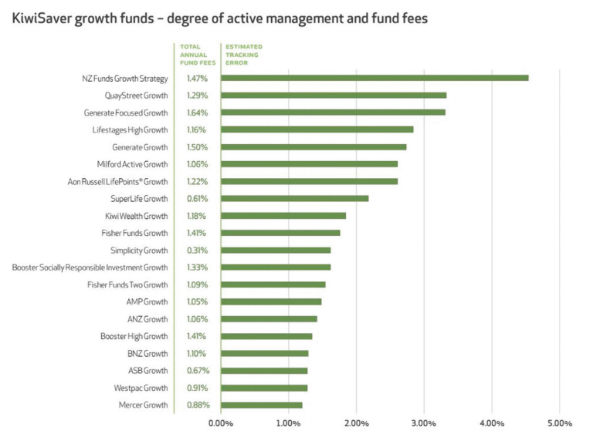
How active or passive a KiwiSaver manager is can be estimated by calculating how much their investment performance deviates from an index. This measure is called a tracking error. The lower the tracking error, the closer the fund is likely to perform to its index.

In the attached table, NZ Funds has estimated selected KiwiSaver growth funds' tracking errors using the funds’ disclosed performance and target asset allocation.1

The data shows NZ Funds, QuayStreet and Generate have been more active than their peers and on average charge more as a result.

In contrast, the major banks and larger institutional managers like AMP and Mercer have both a lower tracking error and a lower management fee. Booster’s High Growth Fund is an interesting exception.
A FINAL WORD ON FEES AND STYLES

The difficulty with comparing degrees of activeness with levels of members’ KiwiSaver fees is that fees go to pay for a lot more than investment management. For example, for the same annual fee some managers are providing access to financial advisers, financial planning software, research on responsible investing, and superior client communications and service levels, while others are not.

These additional services may be of considerably more value in helping clients achieve their long-term financial objectives than whether a manager is active or passive, or the degree that their fees are marginally higher or lower than a competitor’s.


Source: FMA, FE Analytics, Bloomberg. Total annual fund fees sourced from September 2019 fund updates. For more information on indices used and calculation methodology, contact NZ Funds. 

1. The tracking error calculation is an estimate only. The tracking errors are calculated against a proxy market index using historical monthly data for three years to September 30, 2019. An otherwise passive manager, like Simplicity, may exhibit a higher than usual tracking error due to month end pricing times and dates, the choice of asset class indices in the calculations, and assumptions about currency hedging ratios, amongst other things. 

Disclaimer: Michael Lang is Chief Executive of NZ Funds and his comments are of a general nature. New Zealand Funds Management Limited is the issuer of the NZ Funds KiwiSaver Scheme. A copy of the latest Product Disclosure Statement is available on request or by visiting the NZ Funds website at www.nzfunds.co.nz.

Generate offers compensation

Hacked KiwiSaver provider Generate is offering to reimburse members for replacement identification documents, or waive their fees.

It revealed last week that it had been the subject of a data breach affecting 26,000 of its members.

Data including ID documents, tax codes, names and addresses was stolen.

In an email to members, Generate said while it was under no obligation to do so, it had decided to reimburse members for the cost of a replacement photo ID if the photo ID they supplied to it was affected in the data breach and was valid on December 29.

They were told to apply by the end of March.

Those who did not want new documents, or missed the March deadline, would have their annual fee of $36 waived.

"In recognition of the wider impact on other members whose personal information was accessed but whose photo ID was not compromised, we will also extend this waiver of Generate’s member fee for 12 months to them," Generate said.

"The waiver of Generate’s member fee for the next 12 months will be applied to members’ accounts automatically (no action is required from any affected members to receive this member fee waiver).

"To reiterate, the offers that we have noted above are made on an ex gratia basis without any admission of liability and are in addition to the other actions we have taken in response to this incident, including:

"Engaging cyber security experts to immediately secure our online application system and to undertake a broader audit and testing of all of our systems; and engaging IDCARE, an independent identity and cyber security organisation, to provide affected members with specialist advice and assistance. We hope that the offers and steps we have outlined in this ongoing breach response from Generate helps to demonstrate to all of our members how valued you all are to us. In this respect, we will also continue to focus on investment performance, building on our track record to date as one of New Zealand's top-performing KiwiSaver schemes."


Providers disagree on active advantage for responsible investment

Newcomer kōura is taking aim at a KiwiSaver provider's claim that active management provides an edge in catering to consumers' responsible investment demands.

Joe Bishop, Kiwi Wealth chief customer officer, said Kiwis clearly wanted to have their funds invested responsibly but a lack of trust in their provider, and independent information, was preventing them from doing more.

"Kiwis increasingly want their personal values reflected in their investments. They want to know where every dollar is invested and that their fund manager is making sound investment decisions that match their personal values.

"The onus is on KiwiSaver providers more than ever to better meet the demands of their members. In part, that means providers should be adopting and implementing responsible investing practices across all investments, not just a few funds marketed as ‘ethical’," he said.

"Because all our funds are actively managed, we have the flexibility to change our responsible investment criteria to exclude those companies we deem ‘unethical’ and reward those who are performing well on environment, social and governance issues."

But Rupert Carylon, chief executive at new provider kōura Wealth said there were other factors to consider.

"While investors have often preferred an active approach to ESG, as they believe it is better at selecting the required investment characteristics, research from Amundi shows that a passive approach can be just as effective."

That research showed that it was possible to "significantly" improve the ESG characteristics of a passive portfolio.

"Working with an active manager means accepting that manager’s interpretation of what makes for a company with good ESG characteristics. What’s more, the investor is likely to receive only minimal insight into what factors into that interpretation. Public companies are large, complex entities with both attractive and unattractive attributes, and not all investors agree on which are which," Carlyon said.

"The combination of better data on ESG, the scalability of index-based ESG investing, and increased engagement of passive managers with the companies they hold means investors can comfortably look to passive ESG strategies to make a difference in their portfolios."

Bishop said 90% of Kiwi Wealth members said independent certification was important in their decision making.

"Trust is earned, not given, and providers can and should do more to show their members they’re not ‘green washing’. They can be more transparent on the information they’re reporting to members and open up their responsible investing practices to independent scrutiny.

"For example, any member of the Kiwi Wealth KiwiSaver Scheme can find out on our website exactly which sectors or companies are excluded and how we have exercised our shareholder voting influence to effect positive change in the companies we invest in."

"Even if there were consensus on things like nondiscriminatory hiring practices or clean supply chains, how to actually measure and prioritise these values in the stock-selection process is highly subjective. And so for investors with their own clearly articulated priorities, someone else’s idea of what makes for a "good" company can be hard to swallow.

"The combination of better data on ESG, the scalability of index-based ESG investing, and increased engagement of passive managers with the companies they hold means investors can comfortably look to passive ESG strategies to make a difference in their portfolios."