Our $100 billion debt of gratitude

Sir Michael Cullen: The man who helped New Zealanders make better financial decisions.

Every now and then someone comes along who, in their lifetime, puts in place changes which touch not only everyone in their generation, but generations to come. Sir Michael Cullen is one such person.

In 1898, the government of Richard Seddon introduced a means-tested “old age pension”. This pension was available for people 65 and over and was worth around one-third of the average wage. This pension, like most of the later changes, was funded out of current
taxation rather than through a separate investment fund. Subsequently, the age of eligibility declined to 60 and the pension as a percentage of the average wage increased.

However, those who were fortunate enough to be employed by a responsible employer – like my father whose employer was the Auckland Hospital Board – could contribute a portion of their salary to a superannuation fund which paid either a lump sum, or an annuity or the rest of their life based on a percentage of their final salary. 

Life in New Zealand was good. But over the course of a generation things were to reverse. Many financial commentators cite the high inflation of the 1970s, the debt taken on to pay for “think big” projects and the decision to remove the tax deduction for private superannuation payments, as the cause of our nation’s reversal in fortune. But it was only the first in a series of extraordinarily poor financial decisions that led to our current predicament. 

Over the course of several decades, successive New Zealand governing parties decided that individuals who were able to directly manage investments in property or the shares of listed or unlisted companies should pay no capital gains tax. Meanwhile those individuals who relied on others to manage their money were forced to pay full corporate tax rates of around 33%, irrespective of which personal tax bracket they were in.


This contributed to the eighties property and share market booms and subsequent busts, and the gradual decline of the superannuation industry. No one was interested in offering professionally managed retirement funds because of the 33% tax rate. 

Those with property or share management skills got wealthy, while regular savers got penalised. At the same time the age of eligibility for NZ Super rose to 65 and the payment fell to 33% below a “no frills” lifestyle.

In 1992 – a year after Australia introduced compulsory superannuation contributions for all its citizens – New Zealand formed the Todd Taskforce to question whether compulsory retirement savings should also be adopted by New Zealand. Headed by Auckland accountant Jeff Todd, they concluded that a compulsory superannuation option would be “an over-reaction to averting a future fiscal problem”.¹ It is arguably one of the worst financial decisions New Zealand ever made. As a consequence, the average Australian citizen now has around $145,000² in superannuation savings. New Zealand’s average KiwiSaver balance has just hit $19,500.³

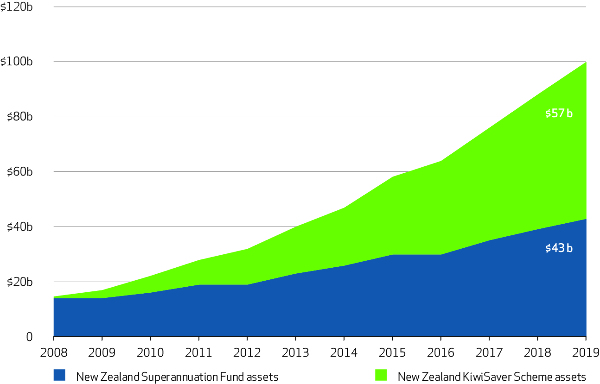
In the 2000s, Michael Cullen (now Sir Michael) changed all of this with three farsighted decisions: the portfolio investment entity (PIE) tax regime, which restored equality of capital gains tax between investing individuals and professionally managed portfolios; the creation of the New Zealand Superannuation Fund – now a world class sovereign fund manager; and KiwiSaver through which New Zealanders have already amassed $57 billion.³ Despite poor historical decisions, one person managed to put New Zealanders back on track.

We all have a role to play in continuing to build on Cullen’s legacy by ensuring that New Zealanders continue to make the best possible financial decisions. The upcoming selection of default KiwiSaver managers will be a significant step on the journey toward becoming a more financially prosperous nation. It is sad to hear that Sir Michael Cullen is unwell. Our thoughts go out to him and his family.

Source: FMA 2019 Annual KiwiSaver Report, New Zealand Superannuation Fund 2019 Annual Report.

1. Todd Taskforce 1992. 2. Australian Bureau of Statistics, 2017-2018 balances. 3. FMA 2019 Annual KiwiSaver Report.

Disclaimer: Michael Lang is Chief Executive of NZ Funds and his comments are of a general nature
CareSaver: Active management doing what it should

New KiwiSaver provider CareSaver is claiming a win for active, ethical management as its funds beat competitors through the Covid-19 market turbulence.

Morningstar has released new data showing that on average, KiwiSaver conservative funds were down 2.98% in March, balanced down 8%, growth down 10.56% and aggressive down 11.91%.

Over the three months to the end of March, conservative funds were down 2.12%, balanced 8.95%, growth 12.39% and aggressive 14.86%.

ANZ’s conservative fund fell 1.7% in the first quarter, Milford’s 3.9% and Booster’s 2.3%. At the same time, CareSaver returned a positive 1.8%.

In balanced funds, CareSaver lost 3.6% compared to 7.4% for Fisher Funds, 8.6% for ANZ and 10% for Milford.

CareSaver chief executive John Berry said investors in CareSaver have benefited from its funds’ active approach to investing, their ability to respond quickly to market developments and their focus on companies with strong environmental, social and governance (ESG) credentials.

“Conservative funds are designed to protect investors from the extreme market volatility we have seen over the last month, so many savers in these funds should question why their investments have performed poorly,” he said.

“Investors trust their manager to look after their retirement savings. Managing investments in a bull market is easy, but bear markets sort out the good managers from the bad. We are delighted with our performance given the very testing conditions we have faced.”

Head of investment Paul Brownsey said it had moved more money to cash as markets fell and focused on quality companies. It had also adjusted its currency hedge. Offshore investments are 70% unhedged because CareSaver sees more downside risk to the New Zealand dollar.

“CareSaver has also actively avoided corporate bonds, and entire industries like hotels, casinos and airlines. Many times, as an active manager, we were up all night following events overseas and responding to new market developments. Compare that to a passive manager that just has to take whatever losses the market serves them.”

Morningstar data director for Asia Pacific Greg Bunkall said CareSaver had held up well.

He said having higher cash balances was a benefit for the manager. CareSaver now has 47% equity exposure in its growth fund, 22% in balanced and 3% in conservative.

“As an ESG/sustainable manager – they are naturally going to be avoiding things that have not performed relatively well. Oil, airlines and gambling are avoided – and they are parts of the market that have been hardest hit. In fact our head of ESG investing in the US has been highlighting research that ESG tilted funds are performing better than general funds.”

Brownsey said companies that were selected based on ESG metrics were more resilient in a down market and had better results in up markets.

Covid withdrawals possible ‘but not always desirable’

KiwiSaver members are being told they may be able to withdraw their money to help them through tough financial times caused by Covid-19 – but the decision should be made carefully.

Retirement Commissioner Jane Wrightson said it was understandable that many KiwiSaver members facing financial hardship were turning to their funds as a potential source of short-term income, but there was a range of options they could consider first.

“While your circumstances may qualify for withdrawal under significant financial hardship, taking out money now may severely impact your quality of life in retirement later,” says Wrightson. “There is a lot of other help available you could access before going down that road.”

She said people could check they were getting the full support available from the Government, could ask for support from their bank or advice from helpline MoneyTalks.

“Avoid making a decision based on fear,” says Wrightson. “Emotional situations tend to lead to poor financial choices, so access the help above before turning to the long term savings and investment that is your KiwiSaver. You will not only crystallise the losses your fund has suffered since the effects of Covid-19 began, but also lose out on future returns.”

For example, a 35-year-old earning $80,000 who has contributed 3% to a KiwiSaver balanced fund since KiwiSaver started 13 years ago could have a fund worth $100,000. If they withdrew $30,000 now, they could have $47,000 less by the time they turn 65.

People who wanted to tap into their KiwiSaver account would need to show they were suffering significant financial hardship as a result of Covid-19.

Some elements of the process may be simplified, such as the requirement to sign a form in front of an authorised witness, to take into account self-isolation and level 4 lockdown requirements.

Liam Mason, the director of regulation at the Financial Markets Authority (FMA), said: “We understand providers are focusing hard on helping their customers through these times of financial uncertainty. We’ve been talking to providers about how they can approach KiwiSaver hardship withdrawals.

“We’ve advised providers and their supervisors to take a sensible and practical approach when they consider these applications. We also want providers to point out there are other forms of assistance available from the Government, that people should look to first. Hardship withdrawals from KiwiSaver should always be a last resort, after other options have been exhausted.”

Is your KiwiSaver manager diversified?

Michael Lang looks at KiwiSaver asset allocation and discusses the benefits of diversification.

Over the last decade New Zealand shares outperformed global shares by 120%. New Zealand shares now trade at a premium to their global counterparts.

Whether your KiwiSaver manager favours local shares over international ones has been an important determinant of historic relative performance, and if history is any guide, it is likely to continue to be so. Despite this there is a paucity of research on local managers’ asset allocation.

WHY DO MANAGERS FAVOUR LOCAL SHARES? 

The basic problem is something called home bias. Investors and managers the world over prefer companies that are listed on their home exchange. These companies follow local laws and regulations, report and are reported on locally, and raise capital and hold AGMs locally. They are therefore easier to follow than their  international counterparts.

In some countries a home bias is more than the warm fuzzies. In New Zealand for instance, the tax regime provides advantages for local investment. For example, Australasian shares are not taxed on capital gains and New Zealand shares enjoy the benefit of imputation credits, removing the potential for double taxation on company distributions. Outperformance during the most recent decade has not hurt allocations either.

WHY OWN INTERNATIONAL SHARES? 

Despite this, there are compelling reasons to be globally diversified. It rarely makes sense to put all your retirement eggs in one basket. When the New Zealand economy faces a regional downturn, as occurred during the Asian crisis of 1997, it is useful to be able to draw down on a portfolio of strongly performing global shares.

Whether managers use risk-parity, minimum-variance, mean-variance, or the more sophisticated Bayes-Stein or BlackLitterman, the conclusion is broadly the same – the right allocation to international shares increases clients’ prospective returns, or for the same level of return reduces their risk. 

WHAT IS THE OPTIMAL ALLOCATION TO AUSTRALASIAN SHARES?

One way to work out a portfolio’s optimal Australasian share exposure, is to look at volatility (or variance) instead of return. New Zealand shares will always have a tax-based return advantage but this does not always manifest itself in superior returns – for example, from 1994 to 1999 international shares returned around twice as much as New Zealand shares.

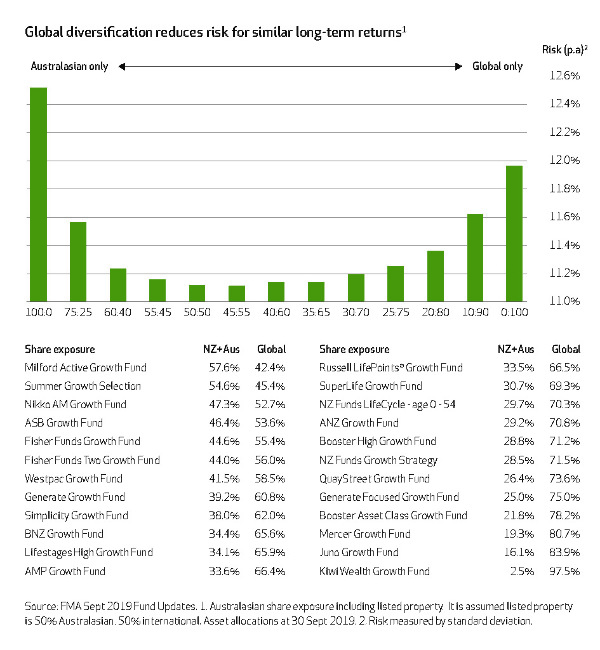
Using minimum-variance to optimise asset allocation gives a range of technically superior allocations – all of which are broadly equal – and shows what is not optimal. The optimal range extends from a minimum allocation to Australasian shares of around 30% where the SuperLife Growth Fund, NZ Funds LifeCycle – age 0-54 and ANZ Growth Fund sit, to a maximum of 55% where the Milford Active Growth Fund is positioned. Funds outside this range are, on this analysis, sub-optimally positioned, most notably the Kiwi Wealth Growth Fund – although the Juno Growth Fund, Mercer Growth Fund and Booster Asset Class Growth Fund also sit outside
the optimal range. Nevertheless, they may have performed well historically. How funds perform in the future will, to a large degree, be determined by their asset allocation. 


Disclaimer: Michael Lang is Chief Executive of NZ Funds and his comments are of a general nature. New Zealand Funds Management Limited is the issuer of the NZ Funds KiwiSaver Scheme. A copy of the latest Product Disclosure Statement is available on request or by visiting the NZ Funds website at www.nzfunds.co.nz.