Generate: Advisers dealing with questions

KiwiSaver provider Generate is encouraging advisers to refer clients who are worried about its recent hack back to its website.

It revealed last week that there had been illegitimate access to its systems. Data about 26,000 members, including their ID documents and passwords, was accessed.

“We know that advisers are fielding questions from clients about this incident, both from affected Generate members and others. We want advisers to know that having taken immediate steps to secure our systems, we are working very hard to assist their clients who were affected,” said chief executive Henry Tongue.

“On Wednesday, as we were sending emails to all our members, letting them know whether or not their personal information was involved, we also contacted all the subscribers to our advisers’ mailing list, alerting them to the incident and recommending ways they could assist their affected clients.”

He said advisers who had clients in the scheme should ask them to log into their Generate account so they could see what information was involved.

They should also go to the website for steps to take to prevent harm.

"Advisers can also assure their clients that this incident affected our online application system information solely, and not our members’ KiwiSaver or other investment accounts, or the investments themselves, which are held in a completely separate system.

"As an organisation we take the protection of our members’ data very seriously. Unfortunately, as advisers will know, malicious attacks of this nature are becoming more common both in New Zealand and globally, so constant vigilance is required, which is why we are taking longer term steps to further strengthen the security of our systems. This is a key priority for us alongside continuing to perform strongly as an investment manager to deliver results for our members.”

Morningstar: Don’t expect another 2019

Investors are still being rewarded for taking risk – but there may not be another year like 2019 for some time, Morningstar’s director of manager research for Asia-Pacific Tim Murphy says.

The research house has put out its latest KiwiSaver survey, which showed some of the top performers in the three months were AMP’s KiwiSaver Default fund, up 0.7%; Generate’s Conservative fund, up 2.1%; AMP ASB Balanced, up 2.9%; Generate KiwiSaver Growth, up 5.2%; and Generate Focused Growth, up 6.6%.

Murphy said it had been a good quarter for the markets, with the NZX50 up 5.2% and 30.4% for the year. Australian shares were up 23.4% over the 12 months.

He said that default funds were the worst-performing group in the survey, which highlighted the need for people to make an active fund choice.

Over 10 years, default funds returned an average 5.7% a year, conservative 6.1%, moderate 6.5%, balanced 8.1% and growth 9.8%. For the year, average annual returns ranged from 23.3% in aggressive funds to 8.5% for conservative.

“I think it certainly highlights again a reminder for KiwiSaver members who have not taken the chance to actively choose that the default options are not necessarily the best place for long-term savings. We’re seeing that now, a far lower return over the long term.”

He said there was a spread of performance, with managers who had more money in equities generally doing better. Those who were more exposed to the US and tech sector globally were doing well, and local technology, utility and infrastructure stocks had also given fund managers a boost.

Over the 10-year period AMP lagged group averages across all types of funds. Murphy said over time the differences between funds tended to become smaller.

But he said investors should not get used to double-digit returns on an ongoing basis and should not expect 2020 to be as strong as 2019.

“I’m confident 2019 will go down as one of the strongest years return wise for the investment market.”

KiwiSaver and social responsibility

Some claims of "social responsibility" may need a bit of further investigation. Michael Lang elaborates.

HOW SOCIALLY RESPONSIBLE IS YOUR KIWISAVER MANAGER? 

Advisers who have been in business for a decade or more will be aware of the power of fads, or as they’re commonly marketed in finance: investment themes. Investment themes are powerful because they can be packaged into a product and used to raise capital.

In the early 90s it was Pacific Basin funds, then emerging markets, followed quickly by technology in the 2000s and more recently, highly cyclical commodities such as gold, water, forestry, milk – and avocados of all things.

Some managers appear to have approached socially responsible investing in the same way, by treating it as a fad with which to raise capital. This is a mistake. 

Millennials get the most attention for values-based investing, but there is growing interest from the older and much wealthier Generation X.

In 2018 NZ Funds surveyed New Zealanders to see what mattered most to them when investing. ESG (environmental, social and governance) rated first, ahead of returns, fees and whether their manager was locally or internationally owned. As a result, NZ Funds’ board decided to take an ESG approach with all the money we manage.

Embracing socially responsible management is not easy for a manager, and it only gets harder for an adviser or an investor as there is no one definition of what is socially responsible and what is not.

HOW MANAGERS CAN ALL CLAIM TO BE SOCIALLY RESPONSIBLE

Any manager with a policy of considering ESG factors must note in their KiwiSaver product disclosure statement whether “responsible investment, including environmental, social, and governance considerations, is taken into account”.

Unfortunately, with the exception of controversial weapons (cluster munitions, anti-personnel mines, or nuclear armaments), there is nothing to stop a manager from “considering” ESG factors and then investing anyway. In this way, KiwiSaver managers can, and most do, claim to be socially responsible.

THE SOCIALLY RESPONSIBLE FAKE NEWS TEST 

Having a list of exclusions (or prohibited investments) based on industry type is the most visible way for investors to understand how a manager may implement their ESG policy.

To test how far KiwiSaver managers go in developing their exclusions, we analysed all their KiwiSaver funds against banned controversial weapons and added six additional categories: tobacco, civilian firearms, gambling, alcohol, fossil fuels and pornography. 

The good news is, over 70% of managers have firm-wide policies to restrict investments in at least one category other than controversial weapons. The most commonly restricted categories are tobacco and civilian firearms. 

However, despite the soothing words of almost all Product Disclosure Statements, only around a quarter of the managers restrict investments in four or more of the categories. Those managers were: Simplicity, CareSaver, NZ Funds, Juno and Kōura Wealth. Simplicity deserves special mention as being the only KiwiSaver manager with a full score.

At the other end of the spectrum were Funds Administration New Zealand and AMP who only excluded controversial weapons. 

In addition, Aon, Nikko, QuayStreet and SuperLife either do not take responsible investing into account or have no specific exclusions in their ESG policies. Some managers had specific funds that had exclusions, but this did not seem to be a firmwide policy.

Managers with limited exclusions may be treating socially responsible investing as a fad, choosing to launch a small number of prominently labelled funds, while quietly managing the bulk of funds with few or no restrictions.

Failing to embrace ESG is, in our view, a mistake. There is increasing evidence that ESG improves rather than penalises returns. A good example is Morningstar’s November 2016 report, “Sustainable Investing Research Suggests No Performance Penalty”. 

It is timely that the FMA has asked for consultation on green bonds and responsible investment products. Hopefully, transparency in this area will improve with time. 
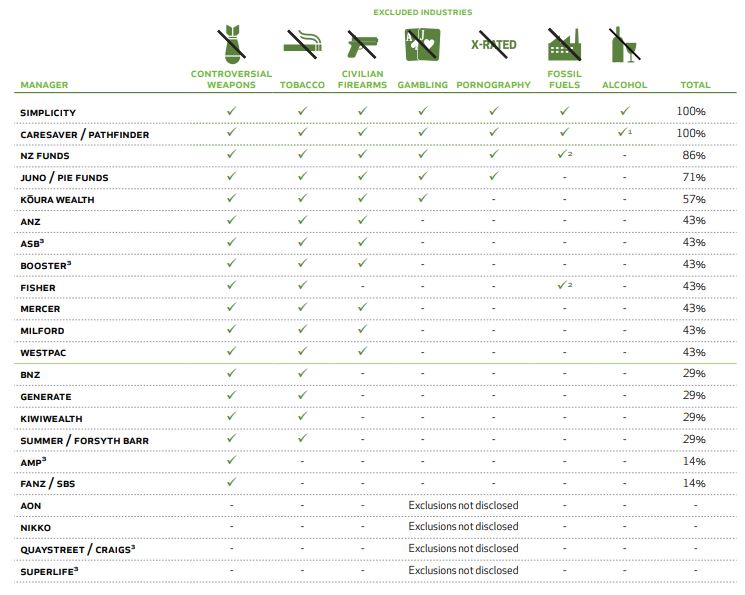


1. CareSaver excludes companies that target young people with cheap alcohol. 2. NZ Funds excludes companies that have more than 10% of their revenue from thermal coal and oil sands. Fisher Funds excludes companies if a significant proportion of their core business is in thermal coal production. 3. These managers have specific funds which have additional exclusions. Source: the public websites of each respective manager.

Michael Lang is Chief Executive at NZ Funds and his comments are of a general nature. New Zealand Funds Management Limited is the issuer of the NZ Funds KiwiSaver Scheme. A copy of the latest Product Disclosure Statement for the scheme is available on request and at www.nzfunds.co.nz.


Kōura: People see advice and KiwiSaver as distinct

New KiwiSaver provider Kōura is providing more advice to KiwiSaver members than initially expected – but not converting as many as had been hoped to members.

Founder Rupert Carlyon said, since the KiwiSaver provider went live, it had given advice to 3,000 people via its digital advice platform.

It has about 100 members so far. Carlyon said he had hoped for twice that number, but co-founder Warren Couillault, who has been involved with the Fisher Funds and Generate KiwiSaver launches previously, said it was a good level of activity.

Carlyon said people seemed to see the KiwiSaver advice and the KiwiSaver fund offer as two distinct things.

“It’s frustrating. We think we’re giving people really good advice and we have good schemes as well.”

But many people were using the advice they received to confirm their current decisions or to go back to their existing provider to make the suggested changes, he said.

“People don’t see the difference between the different schemes.”

He said Kōura needed to become better at explaining why its schemes were good.

Over the next couple of weeks, it would roll out new messaging on the Kōura website, he said.

There had been good feedback on the tools available and the advice process, including from the Financial Markets Authority, he said.

Users step through a process of offering information about themselves and their risk appetite, from which the platform builds a personalised asset allocation.

Carlyon said he hoped people would become more aware of the low level of fees and the ESG options available to help Kōura stand out in the market.