Juno to increase KiwiSaver fees, not pursuing default status.

Juno KiwiSaver funds are increasing fees for some clients, not going to pursue default provider status.

Following an internal review, KiwiSaver provider Juno has announced that it will be increasing fees for some members.

The review focused on key areas for cost for the business arising from their active investment approach, current member base, as well as new initiatives that they are set to announce.

Despite the increase, a statement from Juno says that the KiwiSaver will remain at a competitively lower rate compared to industry standards.

A statement from Juno says that “the average JUNO fee for balances 0-400k is 0.65%, for balances 0-200k is 0.77% and for balances 0-50k is 0.72%. This contrasts to Morningstar data showing the average asset-based fees for KiwiSaver Growth Funds as 1.06%”.

“As recent FMA-commissioned work shows, we are true-to-label active; all three JUNO funds topped their respective Morningstar categories for the year to 30 September 2020.”

Juno has stated that given their current mix of balances, many members will see little to no price increase. Under 13s are still free and members with balances between $5-$15k still pay $5 per month. Nearly half of Juno members will still be paying less than $100 annually in total.

The fee change will come into effect for customers on the 1st December 2020.

The other important announcement from the KiwiSaver provider is that Juno will not be seeking default provider status.

“We have reviewed the request for proposal (RFP) documents and requirements carefully. We are confident our fee structure would be very competitive and offer compelling value in terms of performance and other member benefits. But relative to criteria, we don’t have a long KiwiSaver track record and none at scale. We fully understand the Government’s need to manage the financial and political risk of a provider struggling – or failing – to manage a potentially large number of new default members.”

“We’ve decided instead to continue building focus on attracting members aligned to our value proposition from other schemes, at which we have been increasingly successful (including default members making an active choice to join us). We expect to keep attracting New Zealanders new to KiwiSaver.”
KiwiSaver: The opportunity set of a lifetime

NZ Funds chief executive Michael Lang outlines three ways the financial services industry could further grow KiwiSaver.

“Kiwis are clueless, careless and deluded about money and retirement savings.” This is how our media interpreted the Commission for Financial Capability’s recent financial survey.

For many New Zealanders who work in the financial advice industry, such articles make for depressing reading, and are all too common.

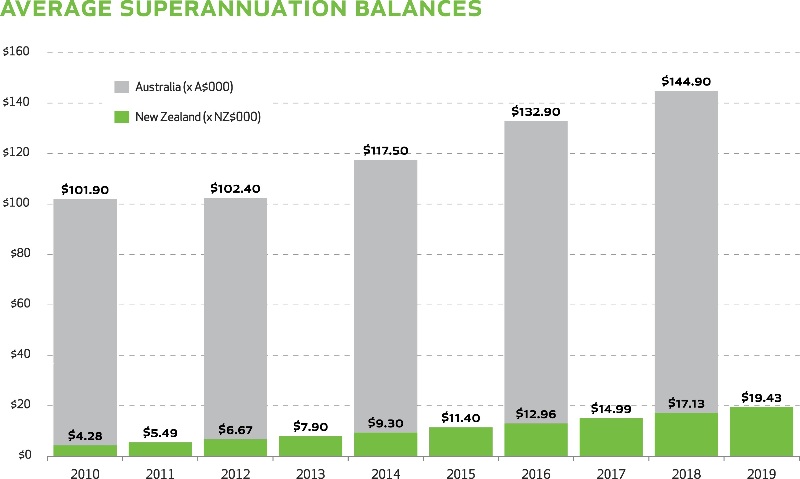
There is no disputing however that New Zealand has fallen behind financially. We could have adopted KiwiSaver in 1992 but chose not to. Right now, saving for retirement is compulsory in Australia at 9.5%, but only optional in New Zealand at 6% (or less). The average Australian has around $145,000 in their superannuation scheme, while the average KiwiSaver member has around $20,000.

This represents the opportunity of a lifetime. One of the more remarkable pieces of news this year was the story that Space-X had successfully sent astronauts into space. While that has been done before, this time was different.

Space-X is a private, for-profit enterprise, and was able to do it faster, cheaper and more safely than NASA. As the first man to step foot on the moon, Neil Armstrong might have said, “One small step for space exploration, one giant leap for commercial enterprises”.

In Space-X’s achievement lies a message of hope for us all. It is easy to lay blame for what should be done at someone else’s doorstep: Government should have made KiwiSaver compulsory; MBIE should have disbanded the default KiwiSaver oligopoly years ago, and so on.

But the truth is, the investment industry should look to itself, not others for the solution. Space-X showed private enterprises have the power to change the future – better than any government or regulatory authority can. If Sir Michael Cullen could help New Zealand accumulate an additional $70 billion in a decade, then imagine what a difference 24 licensed KiwiSaver managers and 9,000 financial advisers could make, if they really want to.

Here are some of the financial needs that New Zealanders have raised with us which commercial enterprises could start to solve:

(a) an attractive way to save more into KiwiSaver, without having the money locked up, so that families can save more but not lose the option of accessing their funds should they wish to;

(b) ways to accelerate the building of wealth through KiwiSaver, without putting their retirement savings at risk (something along the lines of paying down a mortgage on a house over time generates a higher return on equity than buying the house outright); and

(c) more investment options in retirement now that interest rates are close to zero, which has negatively impacted term deposits, bonds and endowment schemes.

Despite the market distortion of default KiwiSaver providers, a perceived focus by the FMA on fees over the benefits of quality financial advice, service and ultimately client outcomes, and the hand-wringing of the Commission for Financial Capability, New Zealanders should know we will get there. And when we do it is unlikely to be because of a single government or regulatory decreed solution (be that ever lower fees or balanced funds for all).

On the contrary, our best chance of solving New Zealanders’ savings shortfall is to encourage strong and profitable market participants who innovate, experiment and compete rigorously (on a level playing field) for a share of the $725 billion-dollar prize, which is what our market will look like when we catch up to Australia.

Welcome to one of our most exciting and important marketplaces since New Zealand decided to deregulate.


It’s time sharebrokers had uniform fee disclosure

NZ Funds chief executive Michael Lang says it is time sharebrokers faced a uniform fees disclosure regime like managed funds.

In New Zealand, on the front page of the Financial Market Authority’s (FMA) website, you will find an orange box titled “How much of your KiwiSaver return is made up of fees?”.

It sits just under the tagline “Promoting fair, efficient and transparent financial markets”. What you will not find is anything on how much a share broker charges to manage your retirement savings.

Fees, or how much a client is charged to have their money managed, is an important ingredient to consider if New Zealanders are to make informed investment decisions. Fortunately, fees are also one of the few variables in finance which are relatively certain (performance fees are of course an exception).

For many years New Zealand was the ‘wild west’ of fee calculations and disclosure. Even if investment organisations had wanted to disclose what they were charging their clients, there was no single set of rules which others were obligated to follow.

This made comparing managers’ fees and costs an exasperating and ultimately futile exercise. And without ‘transparent’ there can be little chance of ‘efficient’.

Fortunately, in 2013 one of the first things the new regulator did was establish a single set of rules for disclosing fees and costs.

The measure labelled ‘Total Annual Fund Charges’ covers managers’ base fees, performance fees, portfolio expenses, underlying manager costs and many more factors besides. It does not take entry and exit fees, brokerage or currency translation ‘mark-ups’ into account.

But as all managers must now follow the same set of rules, it does for the first time in New Zealand’s history allow for an ‘apples to apples’ comparison of the costs of having your money managed. Well, almost.

Missing from New Zealand’s regulatory regime is the multi-billion-dollar share broker industry. New Zealand’s share brokers have long since evolved from promoting individual shares to managing sophisticated, highly diversified investment accounts which contain local and international shares, bonds, ETFs and managed funds.

Many also include alternative assets like private equity and hedge funds. In short, exactly the same investments a fund manager provides, but without the obligation to calculate fees and expenses using the same set of rules everyone else in the market follows.

Sooner or later every financial adviser, whether they work for a broker or fund manager, will be asked by a client to review either their managed fund or broker-built investment portfolio.

Without forensic analysis the adviser will find comparing the costs of two – almost identical investment portfolios – impossible. How then can the adviser provide their client with an informed investment recommendation? They just can’t.

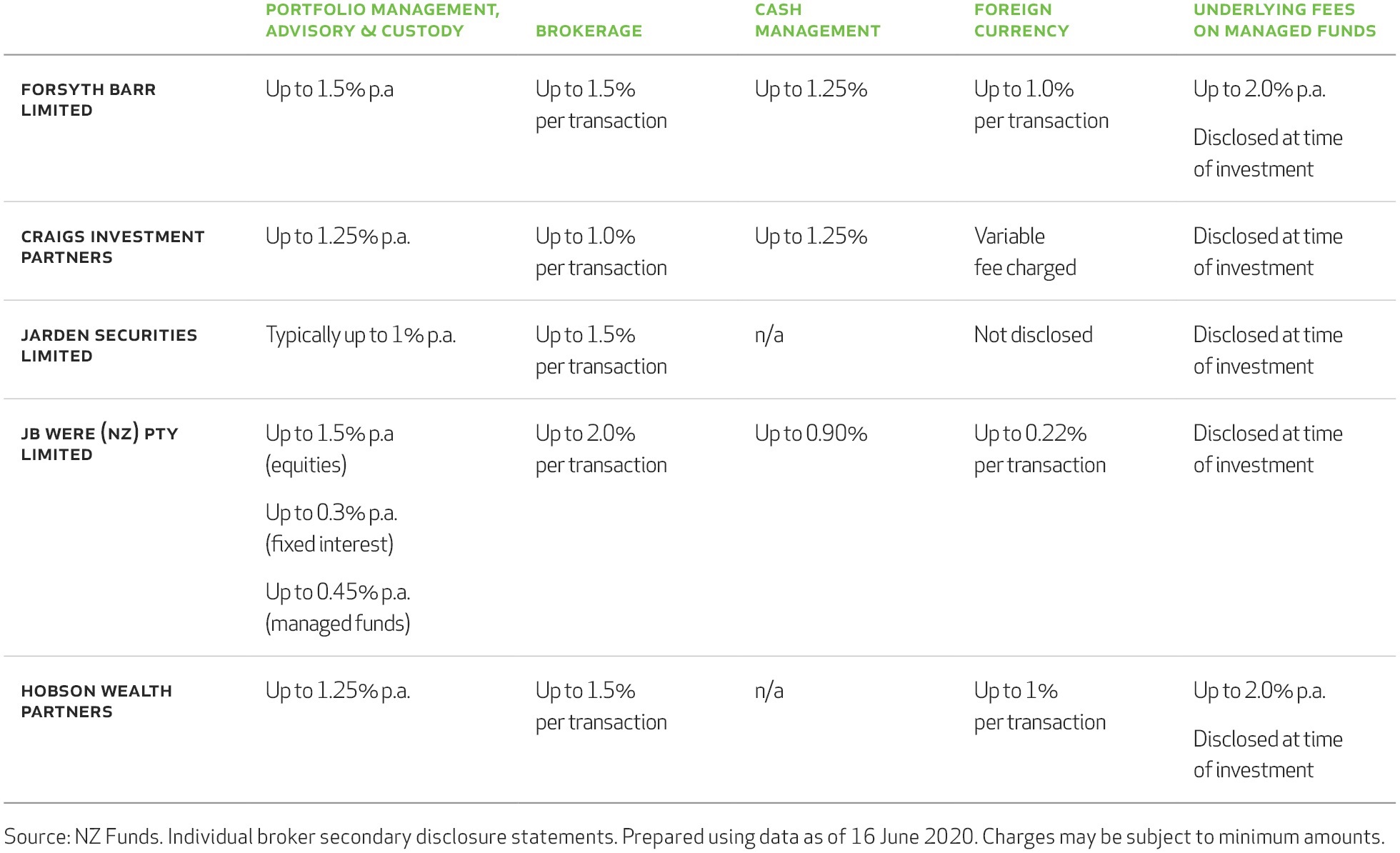
To illustrate the problem, NZ Funds analysed the secondary disclosure statements of the five major share brokers. The results are shown below.

Unlike managed funds, there is no consistency and the disclosures are difficult to understand, even for a market participant. There is also no example of the likely costs an investor may pay. In some client reports, NZ Funds found the estimated fees and costs to be higher than the fees and costs disclosed in the report.

One area that was not disclosed in some client reports was the costs associated with investing in ETFs.

This was not surprising as there is currently no requirement to disclose the fees of the underlying managers of ETFs, listed funds, managed funds, and private equity.

The share broking industry advises on an estimated $50 billion of New Zealanders’ savings. It is directly comparable to the managed funds industry, providing access to exactly the same underlying investments. At the age of 65, the billions accumulated in KiwiSaver will become eligible for withdrawal and re-investment into what may appear to be cheaper share broker accounts.

The regulator has already done the hard work of designing a single set of rules for fee and cost disclosure.

Now, all that remains to be done to facilitate “fair, efficient and transparent financial markets”, is to ensure it is applied equally to the share broking industry in New Zealand, as it already is in Australia.


Tender for default KiwiSaver funds finally arrives

The Ministry of Business, Innovation & Employment has outlined new criteria for KiwiSaver default fund providers as it seeks bidders in a request for proposals released today.

KiwiSaver providers who want to be part of the default scheme will need to offer a low-fee balanced fund that does not invest in weapons or fossil fuels, and demonstrate they can engage with their clients through to their retirement.

“The current nine default providers were appointed in 2014, and the tender process will help determine the next set of providers to be in place by December 2021,” said James Hartley, a general manager at MBIE.

“The aim of this RFP process is to ensure those funds work in the best interests of Kiwis who are in default funds, and to better reflect what people want from them.”

Successful bidders will benefit from a steady stream of new default members being automatically added to their funds, as well as the possibility of having existing members reallocated from incumbent default funds that make an unsuccessful bid.

Scale

As of March 31, there were 380,000 default KiwiSaver members in the nine default funds, with more than $4 billion of funds under management.

MBIE said the ministers in charge of the selection would prefer to appoint at least five providers. However, they may appoint more or fewer to get better value for money.

With nine incumbent schemes competing for potentially only five spaces, it is likely that the winners will get a significant boost from existing default members.

MBIE has a particular focus on lower fees and for providers to up their game on client engagement.

“The fees for these services must fairly reflect the nature of the service provided and the relatively low member fund balances.”

The document suggests this would be limited to a percentage-based and annual fee, without any additional charges. It does allow for “innovative fees structures” if they benefit members and are simple and transparent.

More than half of all default members have a balance of less than $5,000.

The tender deadline is Dec. 18. New providers will be named in April with the new default funds operating from December 2021.