KiwiSaver funds bankroll community housing

Generate and Caresaver KiwiSaver are backing a community housing initiative seeking to raise $100 million in funding for as many as 300 low-cost houses, much of it to be built on unused urban church land.

Community Finance said it had reached the halfway stage of its Aotearoa Pledge targets, with cornerstone commitments of $10m each from the two KiwiSaver providers and ANZ Bank, while Forsyth Barr, Lindsay Foundation and WEL Energy Trust have contributed a combined $11m.

Chief executive James Palmer said the platform, established in 2019 with the backing of the Lindsay Foundation, the Tindall Foundation, the Matua Foundation and Christian Savings, was hoping to see other fund managers, community foundations and businesses "step up this year".

Its latest campaign follows the successful launch of its Salvation Army community bond last year, which raised $40m for the construction of 118 mixed-use homes in Royal Oak, Westgate and Flat Bush, near Auckland.

While that effort comes in at about $339,000 per house, it is known the Salvation Army contributed significantly on top of the funds borrowed from Community Finance.

The return for Generate, which bought $20m worth of those bonds, is 2.3% per annum. Community Finance said it typically charges less than 0.65% to manage the investments, lending and impact reporting.

Palmer said the model is "an efficient and robust solution for financing large scale affordable housing developments and is proven to deliver".

Community Finance said it has $1b in community housing projects on its books across Otago, Canterbury, Wellington, Hawke's Bay and Auckland.

It hasn't confirmed any of the new sites under the latest scheme, outside of several sites in the Waikato, under the WEL community bond investment.

Economist and Community Finance director Shamubeel Eaqub said it was exciting to see private capital in the pledge, as "the housing crisis is too big to be solved by philanthropic funds alone".

"When we can unleash the investments of ordinary New Zealanders, to the benefit of housing New Zealanders, we can move the dial.” 
IRD to fork out $6.6 million for KiwiSaver pay delay

After delays due to a move to a new technology platform, the IRD are having to compensate many KiwiSaver accounts to the tune of $6.6 million.

Compensation of $6.6 million will be paid by the Inland Revenue Department to KiwiSaver members whose payments were delayed by a move to a new technology platform last year.

The switch occurred in April last year, during which IRD put some KiwiSaver employer contributions on hold.

This delay has meant that some KiwiSaver members potentially missed out on investment gains.

IRD has confirmed that it has now passed on the contributions to KiwiSaver schemes and made an additional payment to make up for the missed investment returns.

Inland Revenue will make 644,000 payments, totalling just over $6.6 million, at an average of just over $10.

A spokeswoman for the department said, “Inland Revenue apologises for the delay.” 

Default KiwiSaver: Which providers are fighting to keep their status?

[Updated] Despite a shroud of secrecy from MBIE, Good Returns can report that 7/9 default KiwiSaver providers have applied to retain their status, with two notable exceptions keeping quiet.

It may well be the biggest shake up in the history of KiwiSaver.

As the KiwiSaver default fund providers which were appointed by the Minister of Commerce and Consumer Affairs expire on June 30, 2021, current default funds have had to re-apply to keep their status.

The secret of who is in and who is out is being closely guarded by MBIE. Even the number of default funds positions available has not yet been stated.

Regarding the number of available default funds, an MBIE spokesperson told Good Returns, “The number of KiwiSaver default providers that will be appointed will be determined following the outcome of the procurement process and the subsequent decision by ministers on the appointments.

“As set out in the RFP documentation, there is a preference to appoint a minimum of five default providers, with a higher number appointed only if doing so will not reduce value for money.”

The nine current providers are AMP, ANZ, ASB, BNZ, BT Funds (Westpac), Fisher Funds, Booster, Kiwi Wealth (Kiwibank) and Mercer.

AMP has confirmed that it has reapplied for default status with Blair Vernon, chief executive of AMP Wealth Management telling Good Returns that, “As a default KiwiSaver provider since 2007, we have the experience, track record, capabilities, and client-focus to continue to serve as a default KiwiSaver provider.”

ANZ has also confirmed that it reapplied, alongside Kiwi Wealth, Westpac and Mercer.

Fisher Funds has also applied, with a representative telling Good Returns that “KiwiSaver is a core part of the Fisher Funds business and with a passion for getting great outcomes for our clients, default status is an important part of that picture.”

Booster also confirmed their application, telling Good Returns that it is “hopeful we will get the opportunity to keep helping Kiwi’s during the next KiwiSaver default term”.

There are two notable exceptions from the previous nine default members. Both ASB and BNZ refused to comment on whether they have reapplied to retain their default status.

Whether they have applied or not will be revealed once the minister makes a decision on which funds will carry on with default status.

It is unclear whether new providers will seek default status. One rumoured to be bidding for a place on the list is Sam Stubbs' Simplicity which currently has more than $2.6 billion across all its funds.

Stubbs gave a firm "no comment" when approached by Good Returns.

Those funds that achieve default status this year will have a lot more responsibility than in previous years. The Government has proposed a mandate for default schemes.

The new default funds will have to:

  • exclude investments in fossil fuels and illegal weapons
  • publish a “Responsible Investment” policy on their website
  • change the investment mandate from conservative to balanced fund
  • promote fee transparency and use the procurement process to put pressure on fees
  • engage with their members to help them make informed decisions about their retirement savings.

If a previous default provider is not reappointed, they will be required to reassign their non-active default members among the appointed providers (on a sequential basis in accordance with the KiwiSaver Act 2006).

MJW KiwiSaver survey reveals balanced and growth fund overlaps

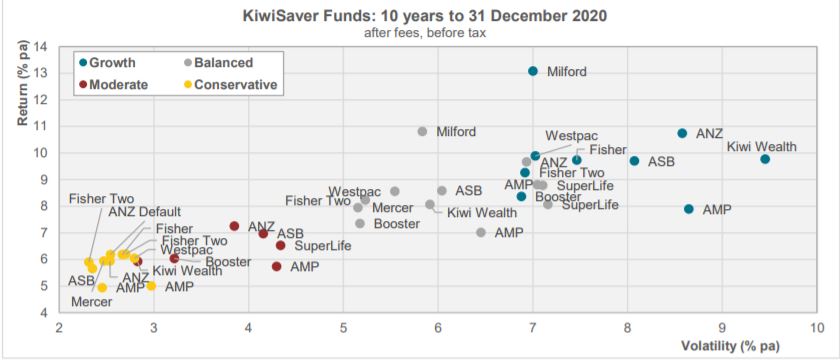
A survey by MJW Investments looking at the performance of KiwiSaver funds over the last ten years reveals a large overlap between balanced and growth funds.

With KiwiSaver now at $62 billion FUM, the superannuation scheme has enough data behind it for the numbers to tell an interesting story when analysed.

A recent MJW Investments survey has reflected on the past ten years of the scheme, analysing the performance of various scheme providers and the differing levels of returns across balanced, growth and conservative funds.

The report says, “As we would expect, fund category (or equivalently, allocation to growth assets) is the most obvious determinant of return. Over the long term, investors can generally expect growth assets to provide a boost to return and this is indeed the pattern we see here.”

Although this is illustrated by the high collection of growth funds towards the top of the returns graph, possibly the most interesting group of data is the number of funds which highlight an overlap in the returns in balanced and growth funds.

The report explains that “there is a relatively large overlap between the growth and balanced funds. Risk and return for the conservative (and moderate) categories are fairly tightly clustered but the spread within categories becomes more pronounced in the balanced and growth categories. The range of returns for balanced funds is around 4% while for growth funds it is over 5%.

“Thus, choice of provider is perhaps relatively more important for the more aggressive funds and relatively less important for the more conservative funds.”

At the top end of the return scale over the decade is the Milford balanced and growth funds which are each outliers with high returns relative to their respective categories.

By contrast, each of AMP’s funds find themselves at the lower end in terms of returns.

The full survey can be found HERE: