‘Retirees’ stick with KiwiSaver, AMP says

More people over the pension age are choosing to keep their KiwiSaver funds active, AMP Wealth Management says.

“We’re seeing fewer KiwiSaver clients withdrawing all their funds when they reach retirement age,” chief executive Blair Vernon said.

“In fact, nearly 7% less than this time last year, representing about $4 million in KiwiSaver investments.”

Vernon said low interest rates were one possible reason for the trend, but said KiwiSaver offered more than a better return.

“Another compelling feature of KiwiSaver for members aged 65-plus compared to some other savings products is the ability to withdraw partial amounts from your funds whenever you like, or need, without incurring any penalty. This can be especially important for this demographic as their needs change.”

The Financial Markets Authority’s annual profile of KiwiSaver members showed an 11% increase in members aged in their 70s in the last two years.

A survey by AMP revealed that more than 25% of respondents expected to still need to be working full-time when they reached 65 and more than 40% thought they would be working part-time.

Financial adviser Michael Cave said the current cohort of KiwiSaver members who had recently retired were most likely very pleasantly surprised at having an unexpected nest egg.

“We know that an increasing number of older Kiwis are struggling to save financially and many hadn’t counted on getting to retirement having built up a good level of savings, but KiwiSaver is helping to change that.

“For those aged 65-plus, the fact that their KiwiSaver money is currently working harder for them compared to bank deposits for example, while also allowing greater flexibility, means it makes absolute sense for them to stay in KiwiSaver,” he said.

AMP pays its own staff their employer contributions at a rate of 12% past 65, although it is not a requirement.
KiwiSaver sector slams National proposal

New Zealand’s KiwiSaver sector has panned a proposal from National to allow unemployed people to tap into their accounts to start a business.

National leader Judith Collins revealed the plan on Wednesday.

The scheme would give people a $1,000 voucher to get advice from a chartered accountant or “registered financial adviser” to talk about their ideas, put together a viable business plan and set up on a system such as Xero.

At that point they would then be eligible to withdraw up to $20,000 from their KiwiSaver account to get the business off the ground.

Milford Asset Management’s head of wealth management Murray Harris said part of the reason KiwiSaver had been so successful was that it was disciplined and clearly intended for retirement savings.

“We need to stop thinking of it as a honey pot that we can dip into for a rainy day or when things go wrong.”

Changes to KiwiSaver risked shaking people’s confidence in the scheme, he said. “The more people talk about KiwiSaver and making changes to it the less confidence people have. They’re worried there will be more change and they won’t be able to access their money.”

There would also be questions of who would decide what was a viable business opportunity, he said. It was unlikely to be something supervisors would want to be tasked with.

Australia has allowed people to dip into their superannuation savings and 3.5 million people had done so. Harris said data there had shown 65% of that money had gone on discretionary spending.

He said withdrawing money could have a significant impact on the final outcome at retirement, which could run into hundreds of thousands of dollars for younger people.

Harris said the idea of a $1,000 voucher for advice was good but it could be made available to help people get KiwiSaver advice.

Adviser Clive Fernandes said it was a terrible idea – he said $20,000 would no be sufficient to get a business off the ground and most people would end up worse off than they started. “It’s a recipe for failure.”

“I support the concept of encouraging people to start a business but I don’t think this is the way to go about it.”

He agreed with Harris that such a change would make people wonder what else the Government might change.

Rupert Carlyon, founder and managing director of KiwiSaver fund provider kōura, told media he thought is was a bad idea and “kind of scary”.

“I think it’s nuts,” Carlyon said.

KiwiSaver was supposed to be a safe and secure back up plan for retirement, he said.

“I’d like Rupert to tell New Zealanders why they shouldn’t use their own money to invest in their own business,” Collins said.

“Rupert is only the first fee-charging funds manager to tell Kiwis who intend starting a new business that he knows how to invest their money better than they do.”

Is default status a gravy train?

Michael Lang compares default and non-default KiwiSaver investment options.

Last month, we questioned why the New Zealand regulatory environment 'gifts' billions of dollars of Kiwi savings to only nine of New Zealand’s 23 KiwiSaver managers, when all managers must demonstrate they are worthy of managing the public funds.

We showed that few of the default managers selected had New Zealandowned parent companies. Additionally, few of the managers selected specialised exclusively in funds management. And finally, we questioned whether, with hindsight, the managers which were
chosen had proven to be more stable and more compliant than the other managers in the market.

This month we examine what happens to the clients who are allocated to nine of New Zealand’s 23 KiwiSaver managers, and ask again whether awarding a selective group of managers monopoly default status is really in New Zealanders’ long-term interests?

Under the current KiwiSaver rules whenever a new employee joins an employer, they are automatically enrolled in KiwiSaver unless they are already a member. Where the employer has not proactively selected a KiwiSaver provider, which few have, the new employee
is allocated to one of the nine default providers at random and invested in their default fund.

According to a Ministerial press release dated December 7, 2006, one of the criteria by which default providers were selected is “competitive fee levels” so unsurprisingly, the fees in default funds are particularly low. However, this appears not to unduly impact the
profitability of default managers as many default members do not remain invested in the default funds for long. They bounce on into higher fee funds, in many cases operated by the same manager as their default fund.

By our calculations, approximately 68% of default members have subsequently made an active choice about their KiwiSaver fund. This makes sense, as the Government has mandated that all default funds must conservatively invest holding no less than 80% in cash  and income assets. As a result, default funds are rarely the best place for members to invest over the long term. 

This begs the question, if default members are going to bounce out of default funds into higher fee-paying funds over time, does the regulator look at the competitiveness of the default funds’ fees (which would be short-sighted), or the competitiveness of the fees  charged across all the KiwiSaver funds the same manager offers (which would make more sense)?

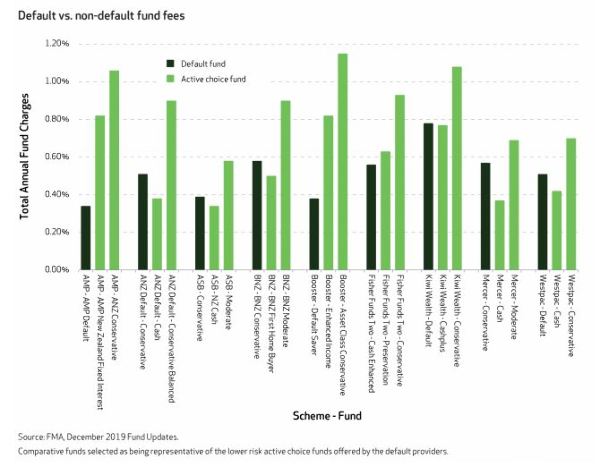
The degree to which default fund managers mark up the fees in their non-default funds is therefore of public interest. The graph below shows that in almost all cases, default managers charge KiwiSaver members more if they move to a non-default fund. The additional fee is often associated with a meaningful increase in growth exposure (and as growth assets are more expensive to purchase and manage than bonds and term deposits this makes sense) but in a select number of cases, members who switch receive little or no additional growth but a significantly higher fee. 

Will the same thing occur in the newly proposed “balanced default funds” regime? Will members end up being switched out of balanced default funds into funds managed by the same managers, with the same or similar asset allocation or a lower exposure to growth
assets, but with markedly higher fees? 

One would hope not but fear so. History teaches us that government mandated monopolies rarely deliver better long-term results than well supervised competition. It is therefore time that managers, advisers and investors, advocate for a level playing field instead
of a sloping one. 

Michael Lang is Chief Executive of NZ Funds and his comments are of a general nature.

Time for financial advisers to step up on KiwiSaver

New Zealand’s KiwiSaver market has probably reached the critical mass required to create opportunities for financial advisers to assist, the Financial Markets Authority’s chief executive says.

It and the Commission for Financial Capability are launching a campaign to encourage KiwiSaver members to engage with their annual statements, which this year include an indication of how much income their KiwiSaver account could be expected to generate when they retired.

Rob Everett said the message to most New Zealanders was to start thinking about what sort of retirement they were on track to achieve and what they needed to do to change it if the income level was likely to be insufficient.

“I have always said there is an opportunity for financial advice around KiwiSaver – the question is of when is it at critical mass. But in terms of balances and people getting past 50, I think we must be there at this point.”

He said recent market movements might encourage more people to seek professional advice to work out whether their funds were working as they should.

Everett said advisers could expect to see the FMA reminding the market every year that annual statement time was a good opportunity to seek advice.

“Even if you only do it every now and again.”

He said the regulator wanted to make sure that even in a period of disruption “and a little bit of panic, everyone takes a step back to look at KiwiSaver as a long-term product”.

Financial Advice NZ chief executive Katrina Shanks welcomed the FMA and CFFC campaign and said it was good to periodically check KiwiSaver settings.

“KiwiSaver is just one of the vehicles used to save for retirement and this is a reminder for people to seek advice on other options.

“We know that for many New Zealanders, financial planning for the future can be daunting, and selecting a quality professional adviser can assist them to provide a comprehensive personalised plan to help them make the right decisions.

“Financial Advice NZ has also been advocating for the Government to provide assistance for people to obtain financial advice in the workplace. We believe that will improve financial literacy and increase people’s financial health, wealth and wellbeing.”