Is more better, or just confusing?

In our new KiwiSaver column NZ Funds CIO Michael Lang asks whether we have too many KiwiSaver fund options available to investors.

Most New Zealanders know that the sums invested in KiwiSaver have snowballed over the last 10 years. A lesser known fact is that the number of KiwiSaver investment funds being offered to the public has also multiplied.

KiwiSaver investment funds should not be confused with KiwiSaver schemes. These are the options each scheme offers. In fact, the number of KiwiSaver schemes has declined over the same period. The number of schemes peaked in 2010 at 52 and as at March 2017, stood at 30. And this included one which was closed to new members.

Why then do the number of funds continue to grow? An increasingly small number of schemes are offering an increasingly large number of funds. In total, the Financial Markets Authority (FMA) data lists over 240 underlying KiwiSaver funds.

AMP, for example, offers its clients a choice of 33 KiwiSaver funds. AMP is not alone in pursuing a menu based approach. Collectively, the top five organisations, ranked by number of funds on offer, offer 140 different funds.

This begs the question: Are more and more funds, offered by the same organisations, necessarily better? Any answer is likely to be subjective and almost certain to be contentious. Nevertheless, with an abundance of information available, some observations can be made.

First, up to a point, a range of different funds is useful, if not essential. Most New Zealanders see KiwiSaver as a retirement fund but an increasing number are initially using it to purchase their first home. 30,256 did so last year alone.

KiwiSaver can also be used as a source of emergency funding, which assisted 13,970 New Zealanders in the year ending June 2017.

Depending on which objective the investor has in mind, one fund may be more appropriate than another. For example, a lower risk income-orientated fund may be more appropriate for a first home purchase in the near future, whereas a higher risk, growth-orientated fund may better suit an individual working and saving for retirement in many years time.

Another good reason for offering a number of different funds is that the level of volatility individual investors are capable of withstanding differs depending on personal preference. This situation can be addressed by offering investors a choice of three schemes: a low, medium or higher risk scheme.

It is not surprising then that a number of large and successful managers, such as Kiwi Wealth and Milford, as well as smaller specialist managers like NZ Funds and newcomer Simplicity, offer their clients a limited choice of well diversified funds, each with a different level of risk.

This means that once investors decide which manager to work with, it is relatively easy to identify which fund is right for them.

In contrast, many of the Australian owned banks and insurance companies offer their clients a bewildering array of funds. Many of these funds are invested in only one type of investment or are restricted to being either onshore or offshore.

Such funds fly in the face of modern portfolio theory; the observation made by Markowitz in 1952 that owning a diversified portfolio of asset types enables investors to earn a higher level of return for the same level of risk.

One large Australian owned institution offers New Zealanders the opportunity to funnel their retirement savings into a small number of locally listed property securities, ten securities making up over 90% of the fund. Only 1,167 investors have taken up this opportunity.

Fortunately, with the help of an adviser, investors can diversify across other funds offered within the same scheme. However, it is not apparent how many have done so.

It could also be argued that this fund might provide a useful stepping stone onto the property ladder, but in 2009 when property prices temporarily dipped providing an excellent buying opportunity, the fund lost 25% of its value.

New Zealand might be better off with fewer funds but more providers offering diversified portfolios. The news that the Japanese owned conglomerate Sumitomo Corporation will offer a KiwiSaver scheme through its wholly owned subsidiary Nikko Asset Management is a positive step in this
direction.
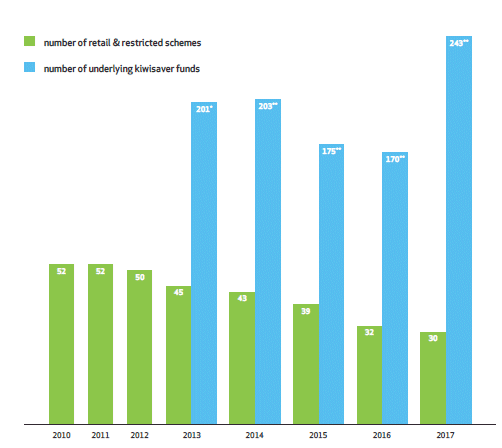
 

* Data as at 30 September 2013, number of funds only relates to KiwiSaver schemes which are open to the public, Craigs Investment Partners KiwiSaver Select Scheme is assumed to be one fund for the
purpose of this analysis.

** Number of funds only relates to KiwiSaver schemes which are open to the public, Craigs Investment Partners KiwiSaver Select Scheme is assumed to be one fund for the purpose of this
analysis.

Conservative attitude a bigger problem than fees: McLachlan

New Zealand’s fund management industry should do more to help shake Kiwis out of their too-conservative approach to investing, one KiwiSaver manager suggests.

Bruce McLachlan, chief executive of Fisher Funds, said his firm’s modelling showed the optimal strategy for a mid-50s investor was to have 60% growth assets at 55 and more than 40% at 60. Even at 90, they would have 20% in growth investments.

“Our analysis suggests a much slower reduction in growth assets is the preferred KiwiSaver strategy,” he said. “Because New Zealand started KiwiSaver so recently many fund managers are using lifestage models from overseas data, where retirement savings have been in place for much longer and at higher levels.

“Because most New Zealanders are way behind there is a need, indeed a requirement, for many to have more exposure to growth for longer.”

By contrast, ANZ’s Lifetimes KiwiSaver options guides investors over 60 into a conservative fund, and into cash over 65.

McLachlan said those who suggested risk be dialled down quickly were subscribing to a school of thought that arose in a time when life expectancies were less.

“We used to retire at 65 and die at 75. That led to a certain strategy. Now, life expectancy is 84 and on its way to 92. We all have to plan for life stages and that last life stage could be an extra 10 or 20 years. The strategy should be different.”

But he said, rather than schemes making changes, New Zealanders’ attitude needed alteration.

The amount of money people had lost over the last 10 years because of their conservative approach was massive, he said.

“It’s everyone’s job. It’s clearly our job, the regulators, the media, the product providers – we all have an obligation to educate and share that knowledge.”

McLachlan said too-conservative investment was a bigger concern than fees, which get more attention.

“If you’re focused on, say 50 basis points of fees and you are missing out on 5% in investment returns, are you focusing on the right thing?”

He said the default KiwiSaver funds should be balanced, not conservative.

KiwiSaver rules for MPs – even if their scheme doesn’t exist any more

MPs including the Commerce Minister claim to be part of a scheme that was wound up five years ago. Good Returns checks out the latest register of pecuniary interests to find out where MPs have their money.

If the working group pondering potential tax changes for New Zealand alters the incentives around KiwiSaver, most MPs will benefit, too.

The latest register of pecuniary interests shows that just 14% of MPs are not members of a KiwiSaver scheme.

Most (25) are with AMP. Another 16 are with ANZ, 14 in ASB schemes and 11 with Kiwi Wealth.

Many MPs also have other non-KiwiSaver superannuation savings accounts.

Prime Minister Jacinda Ardern is saving for retirement in four schemes: AMP’s State Sector Superannuation Scheme, to which she has made no contributions since 2005, AMP’s Retail Superannuation Scheme, ANZ KiwiSaver and a Fidelity Life Super Plan.

National leader Simon Bridges is in Milford’s KiwiSaver scheme and is a member of the St Catherine’s Superannuation Scheme.

Green Party co-leaders James Shaw and Marama Davidson are in Kiwi Wealth’s scheme.

NZ First leader Winston Peters is not in a KiwiSaver scheme but is a member of the Government Superannuation Fund.

National MP Gerry Brownlee and Commerce Minister Kris Faafoi still list membership of an AXA KiwiSaver scheme – this was rolled into AMP’s scheme in 2013.

Minister for Building and Construction Jenny Salesa still says she’s a member of Tower KiwiSaver, which has been part of Fisher Funds since 2013.

It comes as former FSC chief executive and former Revenue and Assistant Finance Minister Peter Neilson lobbies the tax working group, chaired by KiwiSaver initiator Michael Cullen, for better tax breaks for KiwiSaver members.

He made a submission to the group, telling it that New Zealand workers on the average wage cannot save for a comfortable retirement in KiwiSaver. He said his government was wrong to drop tax incentives on superannuation schemes, but at that time, it was only the comparatively better off who had them.

Neilson said contributions and earnings to the schemes should not be taxed, which would enable people to amass larger amounts much more easily. He said, as it was, those who had term deposits and KiwiSaver were at a disadvantage compared to those who built their wealth through investments in real estate.

Call for KiwiSaver tax changes

Tax changes to KiwiSaver are needed to encourage New Zealanders to start saving enough for their retirements, an AFA has told the Tax Working Group.

Drew Hoffman, an authorised financial adviser at Newton Ross, said New Zealanders were saving too little in KiwiSaver – and the lack of tax incentives on the scheme could be to blame.

He said it compared unfavourably to other countries’ structures. In the UK, contributions and fund growth are not taxed but distributions are. In the US, under the Roth option, contributions are taxed, growth is not, and distributions are not.

“Once an employee has contributed up to 3% of his or her salary, there is no incentive for him or her to contribute anymore under the KiwiSaver scheme. A contribution rate of 3% for most people is not going to result in a comfortable retirement,” Hoffman said.

“With the amount of New Zealand Superannuation likely to diminish because of population demographics, the New Zealand government needs to incentivise Kiwis to save more.”

He said the Roth option would be good choice for New Zealand.

“Income and growth on current amounts in KiwiSaver accounts would no longer be taxed and income and growth on additional contributions would not be taxed. I recommend that the limits on contributions be set at $15,000 per annum or 15%, whichever is lower, for employees under age 50. Employees aged 50 and over should have limits of $20,000 or 20%, whichever is lower, to encourage savings for those nearing retirement.”

He said the government was making money off KiwiSaver at the moment, even when the $521 tax credit for each member was taken into account.

“In the future, the amount made by the government on taxation of KiwiSaver will only increase under its current form. The New Zealand government needs to get serious about encouraging people to prepare adequately for retirement. In order to do that, it needs to give up some of its current revenue, otherwise it will have much larger problems on its hands in the future in attempting to fund New Zealand Superannuation.”

The government could drop the member tax credit.

He said employer contributions should also be increased to 5% and employees’ contributions to 7%, with the provision for employers to reduce employee pay to fund the match.

The public consultation period for the Tax Working Group generated 6700 submissions.

“I would like to thank the New Zealand public for taking part in the process and assure everyone that all submissions will be carefully considered,” said chairman Michael Cullen.

About 16,000 votes were received on the quick polls on the Tax Working Group website.

The unscientific polls revealed the majority of respondents thought the tax system needed major changes to be ready for the future.

The prospect of a capital gains tax topped the chart of important tax issues followed by funding retirement and protecting the environment.