What New Zealanders want from KiwiSaver may surprise you

NZ Funds has conducted some research on what people like and what motivates their decisions when making KiwiSaver decisions. It makes for interesting reading.

There has been a lot of conjecture in the media about what KiwiSaver investors should focus on, but less research into what they like and what motivates their decision.

Recent media, and to a lesser extent regulatory focus, has been on fees, but fees came last in a list of attributes ranked through NZ Funds’ inaugural KiwiSaver survey.

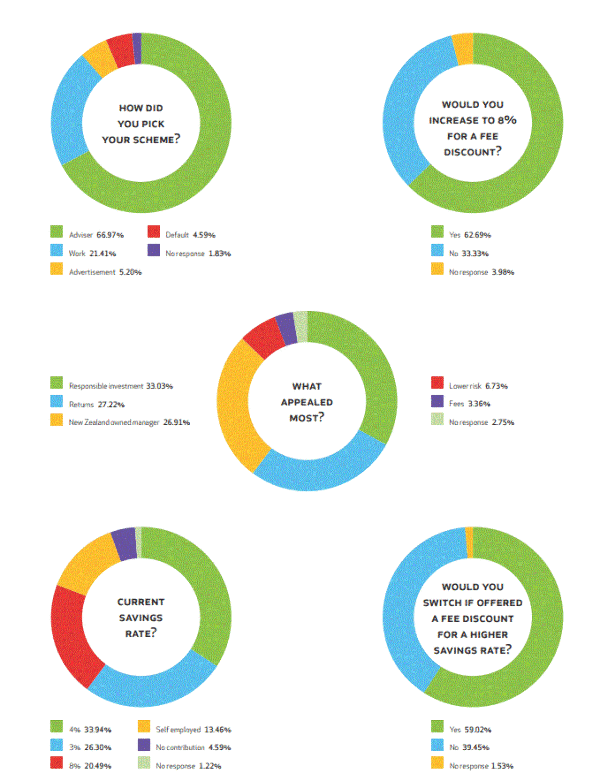
Members of the NZ Funds KiwiSaver scheme, as well as the employees of over 200 firms from NZ Funds Wealth at Work programme, were asked five questions in total. The questions were limited in number to encourage as large a response as possible, but through the survey’s thoughtful design, information was gathered on 19 topics.

Respondents were asked to rank what appealed to them most when selecting a KiwiSaver scheme.

Interestingly, responsible investing ranked highest, ahead of: returns; New Zealand ownership; lower risk and fees, with 35% of the vote.

Returns from most schemes have been strong, reflecting a period of global synchronized growth, so investors have been able to focus on how their returns are being earned. It will be interesting to see if investors continue to value a responsible investment approach during a financial market downturn.

Less surprisingly, returns were ranked the next most important factor with 29% of the vote. This is consistent with investors wishing to see their savings compounding at a faster rate than term deposits, and a corresponding shift away from default schemes toward more growth orientated schemes.

What is surprising is that despite the acknowledged importance of returns, 16.4% of KiwiSaver members are still invested with default schemes. As financial literacy improves, this group should decline.

Another surprise of the survey was how highly respondents ranked New Zealand ownership. The success of the New Zealand Superannuation Fund, managed by its New Zealand investment team, the Guardians of New Zealand Superannuation, has demonstrated that New Zealanders can manage money very well indeed. It might also be the case that what works for Australian or Japanese owned organisations might not be what New Zealanders are looking for, and as a nation we’re cottoning on to that.

Seven percent of respondents rated lower risk as the most important attribute, while only 3% ranked fees as the most appealing factor in a scheme.

It is surprising to see risk receive such a small allocation of the votes. That may change after a market correction.

However, it does show that the FMA has done an excellent job in re-establishing trust between investment managers and the public; and in the idea of KiwiSaver. 

Fees ranked last out of five factors. While fees are an important factor, they are only one factor.

After 10 years it is becoming clear that investors’ asset allocation and contribution rate are the two most important factors. NZ Funds’ research shows that investors’ contribution rate can be nearly three times more significant than fees.

It also reflects that across the board, KiwiSaver fees are fair and reasonable. While different providers provide a different level of fees, they also provide different levels of service.

If you want to be diversified by asset type and/or geographic region, use a multi-manager approach, ensure your funds are responsibly invested and perhaps use an automated rebalancing process as well as have access to a personal financial adviser to help you build your retirement wealth, these things will end up costing you slightly more.

The survey shows that New Zealanders get that.
* New Zealand Funds Management Limited is the issuer of the NZ Funds KiwiSaver Scheme. Download the Scheme’s product
disclosure statement at www.nzfunds.co.nz.


KiwiSaver must change, providers say

Commission should be banned for financial advisers offering advice on KiwiSaver, Milford Asset Management chief executive Troy Swann has told an even in Auckland.

The Commission for Financial Capability this week held its annual summit.

A panel was asked for views on how KiwiSaver should be changed, as it goes into its second decade of existence.

Commission investor education group manager David Boyle said the lack of contribution, general low balances, and the conservative investment profile of many investors, were a major problem for the scheme, despite the large number of people who had joined.

Swann said, among other changes, there should be no commission paid on advice for KiwiSaver in future.

It altered recommendations advisers gave, he said, and was not good for the country.

Milford does not pay commission to advisers for KiwiSaver.

But Liam Mason, head of regulation at the Financial Markets Authority, said financial advice had a key part to play in KiwiSaver.

Members who sought advice and came up with a plan in the years close to retirement had much better rates of achieving their goals, he said.

“If you can get financial advice in the last few years of savings, the outcomes go up dramatically.”

He said New Zealand should be asking “quite a lot of people who get to wear the KiwiSaver badge”. 

Sam Stubbs, founder of Simplicity, which also does not pay commission to advisers, said some providers would experience a shake-up of distribution over the coming years.

“AI is going to decimate traditional distribution channels and advice. It’s free and transparent and transparency is not a feature of the financial services industry. That will happen fairly quickly.”

AI would draw on publicly available information to provide simple personalised advice within 12 or 18 months, he said.

“We’ve said we’re doing to do it, produce an product-agnostic, open-source platform that’s free to everyone. That’s the way that advice gets into the hands of people who can’t afford to get advice.”

Providers who created good products that helped people would do well, he said. But moat-based businesses that relied on distribution channels would face a serious challenge from technology.

Advisers welcome more detailed projections

New Zealand’s financial advice sector is cautiously optimistic about plans for KiwiSaver annual statements to show members what their projected balances could produce in income.

Commerce and Consumer Affairs Minister Kris Faafoi is seeking feedback from KiwiSaver providers on the introduction of the new information.

“We want people to have access to clear, easy-to-understand information that shows how their current savings are tracking towards retirement. Statements will show people an estimate of the savings they will have built-up by age 65 and the weekly retirement income that sum would provide over 25 years.

“How quickly these changes can be made to annual statements will be determined as part of the consultation we are undertaking with providers, but it is my expectation the requirements will be introduced without delay.”

Former IFA president and financial adviser Nigel Tate said it was not a bad idea but the industry had seen projections before. “Consumers have been disappointed as a result of over-projected rates, so maybe but only if the rates were an average of a minimum of the past five years’ returns of that client’s scheme.”

Conservative rates would also be needed to gauge the decumulation phase.

IFA chief executive Fred Dodds said it would be a test to see if clients cared, would inquire, how effective providers’ tools were and whether they would use them.

It might also test bank advice staff, he said.

“If the questions are searching, the 350 to 400 AFAs in the banks will be busy.”

He said it would also be interesting to see how many calls non-aligned advisers received because not all KiwiSaver members are with big providers.

“Hopefully the media and commentators concentrate on the ‘his is a good idea’to actually get people thinking about retirement and not charge off into an undoubted criticism of fees.”

KiwiSaver incentives ‘don’t help those who need it most’

Concerns about KiwiSaver creating inequity in the retired population would be better tackled by abolishing the scheme entirely than introducing new tax incentives to get people saving more, the working group considering the future of tax policy has been told.

The Tax Working Group recently took submissions from the public on New Zealand’s tax system. Rob Dowler, former head of the Securities Industry Association and now an independent industry consultant, provided his submission to Good Returns ahead of the official release of submissions, likely in October.

A number of submissions are understood to have suggested changes to the way long-term savings, in particular KiwiSaver, are taxed.

Former Revenue Minister and former FSC boss Peter Neilson released his, which said his government got it wrong when it axed incentives for superannuation saving schemes. He said earnings within KiwiSaver should be tax-exempt to boost returns.
Dowler said such changes only served fund managers and savers who could afford to save and were doing so anyway.

He pointed to reported comments by the group’s chair, Sir Michael Cullen, in which he said the scheme should be mandatory, to tackle the problem of growing inequity between those people who had saved in their KiwiSaver accounts over their working lives and those who had not.

Dowler said some people were not contributing to KiwiSaver because they could not afford to. To mandate them to do so would come at the expense of their ability to meet their basic living requirements.

“If compulsion is introduced, to ensure that the living standards of this final group are not adversely impacted, government has no choice but to either enhance the income of this latter group to cover the contributions required to be made to KiwiSaver, or alternatively for the government to make some or all of the payments direct to KiwiSaver that such individuals would otherwise be required to make.

“It is at this point that one can ask, in the face of a universal NZ Superannuation payment and minimal poverty reported amongst the aged population, what the point of KiwiSaver is?

“It only has a point if it is believed that NZ Superannuation is insufficient in itself to provide an adequate retirement income, or if there is an as yet unstated intent to replace NZ Superannuation with KiwiSaver or make NZ Superannuation means-tested again.”

He said inequity could better be reduced by abolishing KiwiSaver and allowing voluntary savings for those who wanted it, with support from the pension.

“Retirement saving is simply about having enough money when one wants to retire to enjoy the lifestyle that one aspires to at that time. It does not need to be in a specialised ‘retirement’ fund. Providing incentives, introducing compulsion and locking money away until a specified age simply introduces unnecessary distortion, increases inequity, and reduces personal financial flexibility.

“Even without compulsion, KiwiSaver does all of this, with the restrictions on financial flexibility specifically recognised in the circumstances allowing withdrawal of funds in the case of hardship and buying a first home. KiwiSaver fails to recognise the other costs that the lack of flexibility within the scheme imposes.”