Govt moves to allow early KiwiSaver withdrawal

Government is exploring its options to allow people with life-shortening conditions to access their KiwiSaver money earlier.

Two independent advisers, Claire Matthews from Massey University, and the IHC's Donna Mitchell, will help Commerce and Consumer Affairs Minister Kris Faafoi find the best solution.

Faafoi met with Down syndrome man Tim Fairhall earlier this year, who drew attention to the issue of people in situations like his.

People with Down syndrome have a shorter life expectancy and Fairhall said he wanted to be able to use his KiwiSaver money to travel overseas.

“KiwiSaver helps New Zealanders enjoy the best retirement they can,” Faafoi said.

“Part of the success of KiwiSaver as a retirement savings scheme is because funds are not available until the age of 65, so the savings grow and help people considerably towards a financially secure retirement.

“However, it’s important KiwiSaver works for all New Zealanders. Tim has Down Syndrome and is aging prematurely. He hopes to retire in his mid-40s and access his savings – but at the moment, he can’t.

“I think it’s fair and just that New Zealanders who have been paying into KiwiSaver throughout their working life should expect to one day enjoy the benefits of their savings in their retirement – be that at 45 or 65.”

At present, savers can only access their money for a first home or in serious of sever financial hardship.

”I think we have to acknowledge that the one-size fits all retirement age does not work for this group faced with life-shortening conditions – so we are going to fix that,” Faafoi said.

“Dr Matthews and Ms Mitchell have been tasked with looking into how special circumstances could cater for people like Tim, enabling them to withdraw their money at the point at which they choose to retire.

“The two advisers will consult with people who are faced with this issue, with medical practitioners and KiwiSaver experts, before reporting back to me in early 2019.

“It is a technically complex area so I can’t promise a quick fix for Tim personally but I am going to move this forward because this Government is committed to ensuring its policies work for all New Zealanders.

“Everyone deserves the right to use the money they have saved for their retirement.”

Advice is expected back to the Minister by the end of February. Changes to the KiwiSaver withdrawal criteria would require legislation.

What contribution rate should I have in order to retire?

More specific guidance is needed from advisers if clients are to have the income they require in retirement. 

Let us cut to the chase, KiwiSaver was formed to ensure New Zealanders could self-provision for retirement.

Its predecessor, NZ Super, which relies on tax payers funding the generation ahead of them, is failing.

One need only reference the Westpac-Massey-Ed Centre’s annual Expenditure Guidelines study to see NZ Super’s current “inflation adjusted” payment level does not meet a “no-frills” lifestyle, or The Treasury’s projection that 27% of the population will be 65+ in 2060, up from 15% today.

Only 58% of the population is expected to be between 15 – 64 meaning every retiree will be supported by just two working age people. Today there are 4.3 working age people per each retiree (1).

About the only people not to acknowledge it are the politicians.

Financial advisers, unfortunately live in the real world and must face reality on almost a daily basis.

It is therefore amazing that after nine years, and $55 billion of savings in, the most basic question: “What contribution rate should I have in order to retire?” is too often met with a blank stare, or worse, a swift change of subject to which of the 252 funds (2) on offer is superior to the others based on a nuanced and technical difference in returns, fees, service, active, passive, or all of the above; the industry’s smoke-screen for, “I’ve no idea”.

Another industry favorite is “well, it depends” which is, as we will see, kind of true, but equally unhelpful when helping an individual select their contribution rate.

The current statutory minimum for an employee is 3%.

At this level they are able to take advantage of their employer’s matching contribution of 3% less tax, for a contribution rate (as a percentage of pre-tax salary) of 6% less tax so let us say 5%.

But while everyone acknowledges that this is too little to fund your retirement, there has been little effort to either raise the contribution rate to a safer minimum or bridge the financial literacy gap that exists.

A good starting point is the savings rates settled on by regulators in more financially sophisticated jurisdictions.

In the United States, where 401K plans were introduced in 1978, the average employee saves 7% of their income.

In the United Kingdom, where pensions which have been a feature of workplace benefits for over 100 years went compulsory in 2012, it is 8% minimum from 2019.

Australia, who bit the bullet in 1992 (an opportunity the Todd Task Force of 1992 bungled for New Zealanders), the savings rate is 9.5%, increasing to 12% by 2025.

These numbers all fall within a similar band, and are all higher than those in New Zealand.

Here is why. The starting point for everyone is their current standard of living. If one properly provisions for retirement, then the average retiring individual (or couple) should not suffer a sharp fall (or expect a significant rise) in living standards. Based on data from NZ Funds’ financial planning software, the average New Zealander wishes to retire on 61% of their current income.

Implicit in this is their retirement is topped up by NZ Super; that work-related expenses, transport, clothing etc. are replaced by leisure activities; and that children, mortgage and savings activities cease.

We have, over the last 30 years, found this a bit light and round it up to 70%.

In this way, planning to retire on 70% of your working salary broadly equates to retiring on 100% of your disposable income.

This ratio combined with the expected level of NZ Super and life expectancy determine how much an individual needs to accumulate to fund their retirement.

It is then a simple matter of selecting the right savings rates. Whether all of this savings is channeled into KiwiSaver, or spread between KiwiSaver and Superannuation Schemes (which can be accessed from 55 years of age instead of 65 years of age), is an interesting topic in itself.

The most problematic issue, the mortgage and family home, is often the most simple.

As with standard of living in retirement, most families end up owning homes which are broadly in line with their level of earning.

We estimate using our database that a family in Auckland earning $100,000 per annum would on average own a $600,000 home, while a family earning $200,000 per annum owns a $1,000,000 home. So while the dollar sums will differ on a case-by-case basis, the relative to income percentages do not.

Similarly, most families will end up paying off their mortgages before retiring, on average at age 64.

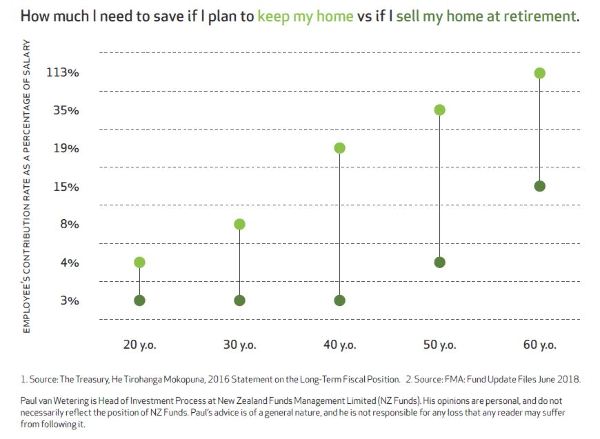
Whether a family wishes to “release” some or all of the equity they build up in their family home in order to fund their retirement is the single biggest determinate of their savings rate.

For families who do not wish to use their home in retirement, this gives them a backstop, should one or both live longer than expected, or an inheritance to leave the next generation.

In this case, the savings ratios rise with age (as shown below). For families who wish to use some or all of their home equity to fund retirement, the  retirement savings ratios are lower.

Interestingly, if you plan on using all the equity in your home in retirement, then the minimum KiwiSaver employee contribution rate is appropriate for you until the age of 50.

For everyone else who enjoys living in their home, not having to worry about living a little longer, and being able to leave something for the next generation or a cause of their choice, there is a need for them to increase their contribution rate.

As many New Zealanders do not realise this, it represents a once in a lifetime opportunity for financial advisers to make a significant contribution to their clients’ future prosperity and peace of mind.
 

KiwiSaver tracker an own goal?

If the Financial Markets Authority's KiwiSaver Tracker was designed to make investors wary of higher-fee funds, it is not achieving its goal, one fund manager says.

The FMA has updated its KiwiSaver tracker, which shows fees as a percentage of funds' five-year average return.

Aggressive funds ranged from Mercer High Growth's 7.9% of return paid in fees to 17.2% for Booster's Geared Growth fund and 23.5% for NZ Funds Growth Strategy.

Growth funds varied from ASB's 5.5% to NZ Funds' Inflation Strategy's 21.3%.

Cash funds had high fee-to-returns ratios because their returns were so low.

When it was launched, the FMA said the tracker made it clear that there was no evidence that paying a higher fee got a better return.

But Booster's outgoing chief investment officer David Beattie said that was now not so clear.

He pointed to the scatter plot with the data which shows that all the lowest-fee providers have after-fee returns at 5% or below. 

The best performers in the market hit more than 15% over five years.

The highest performers after fees over the five years were the Quay Street New Zealand equity fund (15.1% return, 1.3% fee, OneAnswer International Share fund (14.5% return, 1.1% fee) and OneAnswer Australasian share fund (14.4% return, 1.1% fee).

“At best there’s no relationship and when all the funds are together there’s potentially a positive correlation between fees and returns. We wouldn’t disagree with that.”

The most expensive KiwiSaver fund was the Lifestages Growth Portfolio, at 2.8% fees and a return of 9.1% after fees and NZ Funds Growth Strategy with 2.7% fees and 9.9% returns.

Booster’s Geared Growth fund also had fees of 2.7% but Beattie said that would soon change because it would no longer have to include its interest costs as part of the calculation. The fund borrows to leverage up its total exposure to equities. “They are not fees paid to us, they go to the bank as part of funding the facility.”

That would cut the fees recorded in half, he said. 

Beattie said the onus for anyone charging fees that were higher than the average was to justify how they were adding value.

“If you aren’t you will go out of business because investors will go to those who are better at proving they are adding value or who say they offer cheap fees and don’t add a lot of value. The evidence does not support the proposition that the higher the fee the lower the return after fees.”

He said when funds went into negative returns the percentage calculations would look meaningless.

“It’s useful to plot the return versus fees but not to portray it as a percentage.”


30 Years in business

Why Asset Allocation and Advice beat everything else?

Financial advice is much like other professional services; if clients put their mind to it they could probably do most of it themselves. Little of it is rocket science.

But just as we don’t want to spend our weekend doing the family’s tax returns, writing a will or establishing a trust, an increasing number of New Zealanders are embracing the use of a financial adviser to ensure they get the basics right.

So, if you have decided to make a living advising others what to do with their money, you will want to know the best way to grow your clients’ wealth, and then recommend that to as many clients as possible.

The good news is, in our view, the formula for success as a financial adviser is surprisingly simple.

What is also surprisingly simple is that experts around the world from Buffett to Bogle agree that it has little to do with active or passive, global or local, choice of manager or how much they charge; and everything to do with asset allocation and advice.

Here are the five most common discussions we have had with advisers over the years around asset allocation and the role of advice.

First, whether asset allocation explains 70%, 80% or close to 100% of investors’ returns over time. While there is some debate on the exact power of asset allocation, there is little to no debate that everything else from fees to manager alpha ranks far, far behind.

So, if you wish to maximise the returns your clients get over time, make sure you get their asset allocation right.

Second, getting their asset allocation right is also pretty simple. Unless your client is risk averse and/or vulnerable, or needs to access their capital over the short to medium term, then within the confines of KiwiSaver, investing in listed shares is the best long-term investment they can make.

It actually does not matter whether they choose New Zealand, Australian, or global shares (or all three) as they all have a similar long-term rate of return.

Third, encourage clients to save more. At between 5% and 6% (employer and employee contributions), New Zealand’s minimum statutory contribution rate to KiwiSaver is well below our global peers: the United States is saving 7%, the United Kingdom will be saving 9% from 2019, and Australians save 9.5% due to increase to a whopping 12% by 2025. As long as your client is not deeply indebted and has their mortgage repayments under control, there is little danger in encouraging them to save 1% more.

Clients can always take a savings holiday, reduce their savings, or under exceptional circumstances draw down on their funds in an emergency. But they can’t get back lost years of saving.

Fourth, help them stay the course. It might seem silly, but clients pay advisers to hold their hands. Advisers like to think clients use them because they have Bloomberg, can access thousands of funds or subscribe to manager research.

But most industry research is available online and almost all managers are directly accessible at a reasonable price. The thing clients value most, and are quite willing to pay for, is counsel.

Most New Zealanders know that volatility is the price to be paid for a higher expected return, but it is encouraging to hear a professional say it when the markets are down.

Fifth and finally, as clients age they need help unwinding their portfolios. At some point for all of us, the pendulum will swing from wanting to accumulate more to wanting peace, quiet, and a stress-free environment to enjoy the money we have saved.

Clients who have saved enough with which to retire may not want to put the decade or more they have in retirement at risk just to earn two or three percent more.

Because of this, high allocations to growth assets become as inappropriate for older clients as high allocations to cash are for young savers.

There are of course countless ways to refine the process, and layers of value that can be added over and above what is discussed here. But for professional financial advisers, whether they are AFAs or RFAs, getting these basic five things right is of tremendous help to clients, and to society as a whole as it can reduce the burden on taxpayers to fund New Zealanders’ retirements.

Most importantly of all, good advice improves the utility we extract from the incomes we earn.

Happy holidays to advisers and their clients everywhere.