KiwiSaver gender gap widens further, average balances drop

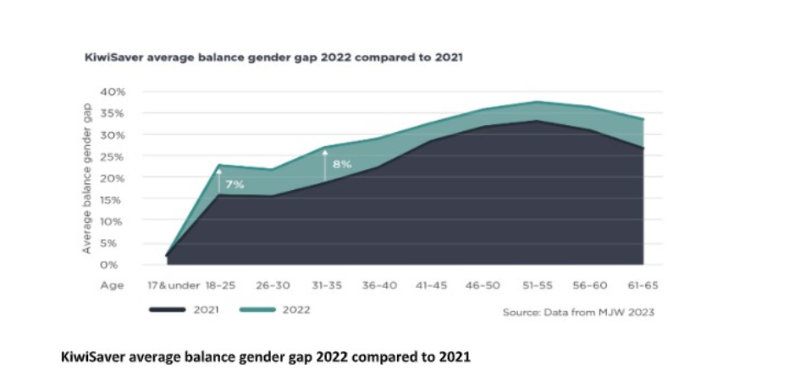
The gender gap for average KiwiSaver balances widened five per cent from 2021 to 2022, increasing from 20 to 25 per cent.

New data from the Te Ara Ahunga Ora Retirement Commission shows gender gaps in every age category widened with larger gaps opening in younger age groups, up 7% to 23% for 18-25 year olds and up 8% to 27% for 31-35 year olds.

Melville Jessup Weaver (MJW) actuaries was commissioned to collect KiwiSaver demographic data as at December 2022 to update data first collected as at December 2021.Data was gathered from more than three million KiwiSaver members and represents approximately 94% of the total KiwiSaver member base.

Te Ara Ahunga Ora Director, Policy and Research, Dr Suzy Morrissey says the research builds a picture of the challenges women face to grow their KiwiSaver balances.

“Analysis of the widening gap does not appear to be explained by fund choice, withdrawal, or suspension behaviour of women compared to men.”

She says the widening of the gap at younger ages is particularly concerning because of compounding interest.

“Money invested earlier will have time to grow, but if women’s balances are lower than men’s in younger life, they will likely remain lower,” says Dr Morrisey.

Analysis was also done to understand the impact of significant hardship withdrawals, first home purchase withdrawals, and savings suspensions using additional from Inland Revenue. Withdrawals and suspensions did not explain the differences – more men were on suspensions and had withdrawn more money. It was noted that data does not capture those who have left paid work and no longer contribute (not a savings suspension).

The report shows that the average KiwiSaver balance as at 31 December 2022 was $27,379, a drop of 5.7% from 2021, reflecting poor financial market conditions over the 2022 year. Balances dropped across all ages, and both genders were impacted.

For males, the average balance fell 3.2% (to $31,496).

For females, the average balance fell 7.1% (to $25,144).
More men in growth funds

The research has also investigated member balances across age and gender by fund type for the first time. It found that more than one third of all funds under management are assets invested in growth funds, this allocation decreases with age.

Men have more assets invested in growth funds, while women have more assets invested in conservative funds. This difference is smaller at younger ages and more pronounced for those nearing age 65, and over 65.

Analysis suggests that women are not necessarily more risk averse, as both men and women tend to be invested in lower risk funds if they have small balances and have more growth assets if they have larger balances. Women’s lower balances (on average) may lead them to be less risk-seeking.

The widest gaps of average balances are still between men and women in their 40s and 50s, which likely reflects the combined impact of the gender pay gap, time out of paid work, and the higher percentage of women than men that work part-time.

On average women in their 40s have approximately $10,000 (or 34%) less KiwiSaver than men; and on average women in their 50s have approximately $14,500 (or 37%) less KiwiSaver than men.

Other findings:

41% of KiwiSaver members have a balance of less than $10,000

  • 60% of which are
  • 35 and younger, a quarter of those over the age of 35 have balances under $10,000
  • 1 in 5 of those aged 51–65 have less than $10,000.

38% of KiwiSaver funds are invested in growth funds

  • for the under 50s, this is around half of investment balances, decreasing to 30% for those aged 50–65 and less than 20% of investment balances for those over 65.

Women have more assets invested in conservative portfolios, while men have more assets invested in growth portfolios.

  • this difference is small at younger ages and more pronounced at older ages.
  • this does not necessarily reflect different risk profiles; it could relate to balance size, as those with lower balances may be invested in lower risk funds.

The 2022 Review of Retirement Income Policy found that 40% of people aged 65 and over have virtually no other income besides NZ Super and another 20% only have that, and a little more.


National Capital hits $100m for KiwiSaver advice

Digital financial adviser National Capital has hit $100 million in KiwiSaver funds under advice.

National Capital founder Clive Fernandes says with the KiwiSaver total approaching the $100 billion mark ($971 billion in Q1 according to the Reserve Bank), a huge proportion of New Zealanders are still not getting any advice on their KiwiSaver accounts.

He thinks while advising on KiwiSaver has not historically been a viable business model for independent and small firm advisers, the advance of digital tools means this may no longer be the case.

National Capital has built its business giving digital or robo advice through its inhouse-built platform. It has spent close to a $1million building and refining its system and now has a development team of four programmers and designers.

Fernandes, who was 20 years in the IT industry prior to starting National Capital, is also involved in the development side. He started the Auckland-based firm four and a half years ago when it became one of the first financial advice companies to get a digital advice exemption from the Financial Markets Authority. In 2021 it was acquired by Auckland-based financial planning company Saturn Advice.

Fernandes says National Capital now has close to 2000 clients, with an average account balance of $50,000. Over the past two years there has been growth in six figure balances and, in the demographic approaching retirement age, $1 million accounts.

“Approximately the revenue is about 0.2% per year. That just isn’t enough money for a human adviser to go out there and give advice one client at a time. A small adviser wouldn’t be able to use that model so we need to encourage advisers to use digital tools.”

Fernandes says with $100 billion in KiwiSaver funds the industry doesn’t need to compete for a slice of the pie.

“There is no way one company can advise on all of this. We should be working together to build a knowledge base and offerings to do a better job.”

He says National Capital wants to talk to independent or small firm advisers and is willing to share its digital knowledge to see if there are suitable tools available in the market, or if National Capital could partner with them.

“At the moment it’s nothing specific, more a conversation. Financial advisers should start collaborating to find solutions that smaller advisors can use.”

National Capital is paid by KiwiSaver providers that include advice in their management fees. This includes AMP, ANZ (ANZ and OneAnswer), Booster, Fisher Funds (Fisher Funds and Fisher Funds TWO), Generate, Mercer, Milford, Nikko and Pathfinder.

“It’s similar to the way mortgage and insurance brokers work but we don’t need to move someone to a provider to get paid.”

National Capital also gives advice to clients of providers that don’t include advice in their fees, such as Simplicity.

“They will still get a basic recommendation of what type of fund is suitable and which provider, but not ongoing advice on the recommended fund or updated recommendations.

“Our whole business model is based on the fact that we are giving a lot of automated advice.”

Fernandes says there are a range of issues including people not properly understanding what KiwiSaver is, confusion about the range of providers and funds, and among those closer to retirement age, worry that they don’t have enough in their accounts. “It starts as an educational journey and then we recommend the right fund.”

He says while many of the banks and providers now offer digital tools, most are risk profilers.

“They ask how comfortable you are with volatility which I don't think is how advice should be given. That is not what a real life financial adviser does. They give advice based on the person’s situation, income etc.  This is what the National Capital system does.”

Generate puts $20m into new Icehouse Ventures fund

Generate KiwiSaver has committed $20m to Icehouse Ventures’ Growth Fund II, a $100m venture capital fund to 20 established New Zealand technology companies to expand in global markets.

Generate chief investment officer Sam Goldwater says, Generate was attracted by the unique deal flow and insights of Growth Fund II as a result of Icehouse Ventures’ investments in >300 early-stage startups.

“Having these kinds of relationships, built over time and successive investments, gives Icehouse Ventures privileged access to new deals coming through, which should enhance returns for our KiwiSaver and managed fund customers.”
Icehouse Ventures is New Zealand’s most active Venture Capital group according to the 2023 Technology Investment Network Report. It has invested in approximately half of all early stage technology startups funded in New Zealand over the last six years.

Robbie Paul, CEO of Icehouse Ventures, says Generate’s backing signals the KiwiSaver provider’s evolution into an institutional-grade fund manager.

“Sam and the Generate team have watched us closely since the launch of our first Growth Fund in 2020. A $20m cornerstone investment in Growth Fund II is a wonderful endorsement coming from an investor that serves almost 130,000 Kiwis,” says Paul.

Four months after launching, Growth Fund II is on track to a first close of $50m, a milestone that took 12 months for Growth Fund I. The fund is open to wholesale investors and the minimum investment is $50,000 which is paid over a three year period.

Paul says the high investor demand for Growth Fund II, in defiance of global venture capital trends, underscores Icehouse Ventures’ unique position in the market and high-trust, long-term relationships with many investors.

Icehouse Ventures’ transition into later stage investment has corresponded with its work toward becoming the most data-driven Venture Capital firm in the Asia Pacific. Its five person product team, led by CTO Peter Thomson, analyses and compares data across the firm’s 308 investments over the past decade to make more accurate and informed decisions. 

“The most informative data is built over time. There is a big difference between looking over the books for a month versus tracking a company's progress over many years,” says Paul.

“The super power we are building is based on blending quantitative data sets on metrics like revenue growth with qualitative observations such as the ability of a CEO to communicate an ambitious vision or to attract and retain great talent.”

However, Robbie emphasised deal access is a critical feature in a market that increasingly includes global venture funds.

“When you’re looking at the meteoric revenue growth of the likes of Tracksuit or Hnry, deal access becomes more important than traditional due diligence. That is where our unique relationships, information, and pre-emptive rights have served us well,” says Paul.

Growth Fund I

Growth Fund 1 raised $110m in 2021 from investors including Simplicity, an Iwi, Hobson Wealth, and >500 high net worth investors and family offices from around the world. There have been 32 investments to date including Halter, Hnry, Dawn

Aerospace, Crimson Education, and Mint Innovation. (Recent press related to Fund I companies: Nilo, Vertus Energy, Halter, Dawn, Biolumic, Sharesies, Tracksuit.)

Aggregate annual revenue by the portfolio exceeds $250m – an increase of $100m from when the Growth Fund first invested. Nine are generating more than $10m, three are pushing $20m, and one exceeds $100m in annual revenue.

Icehouse Ventures funds has attracted investment from more than 1,500 high net worth investors and a growing number of institutional-grade funders including Simplicity, Harbour Asset Management, Hobson Wealth, and Ngati Apa ki te Ra To.

Budget boost addresses gender imbalance on KiwiSaver

Under the heading ‘backing parents of young children’ the government has taken aim at the on-average lower KiwiSaver balances of women compared to men.

In the Budget, the government acknowledges that taking parental leave is one of the main reasons women fall behind, saying it will spend $19.6 million total operating to match KiwiSaver ‘employer’ contributions to people taking paid parental leave.

Last year a report by the NZ Institute of Economic Research (NZIER) commissioned by Kiwi Wealth (now part of Fisher Funds) found a twenty per cent gender gap in the average KiwiSaver balance of men and women.

The report attributed the disadvantage to women taking time off work for childcare, as well as the gender pay equity gap and low confidence of women in making KiwiSaver investment decisions. The estimated financial impact of a one year break in contributions was put at $15,100.

The NZIER report backed up a previous one by the Retirement Commission which also found that on average men had twenty per cent more money in KiwiSaver schemes.

The government says the new funding acknowledges the unpaid nature of childcare and incentivises recipients of paid parental leave to save for their retirement.

“This is further support for parents wishing to take time off work during the first critical months of their baby’s life following the 2018 increase of paid parental leave to 26 weeks.”

Financial Services Council (FSC) CEO Richard Klipin says the move is good news but won’t address the gap.

“New Zealand is facing significant headwinds as they head into retirement.The earlier we start the better and supporting parents when they are having their own children and out of the workforce by supplementing KiwiSaver is a very welcome development.”

Klipin says the FSC wants a proper review of KiwiSaver settings.

“Not only for parents but for all New Zealanders in the context of this being a 15 year old system, and the settings haven’t been adjusted in that time.”

He says there have been signs in the past that the government was interested but these were overtaken by events in the past few years. “Obviously we would welcome them to put it back as a priority.”

Jo Cribb, co-founder of the pay equity initiative MindTheGap also welcomes the news but would like to see the gender pay gap addressed as well.

“It’s a great step forward but we need to look at the bigger picture. Some of those savings can get eaten up through what happens in our workplaces.”

“A key thing the government needs to do is introduce pay transparency. That would potentially be the biggest contribution to women working full time.” A report commissioned by MindTheGap last year analysed public pay gap reporting impacts in seven countries and showed mandatory reporting can reduce gender pay gaps by 20 to 40 per cent. 

Cribb also calls on investors to do more in this area under the auspices of ESG investing.

“I think pay transparency and treating employees equitably is a really important marker of the health of an organisation. I would say to investors, if they haven't got a handle on this, they probably haven't got a good handle on what's happening in the organisation. I'd love to see more investors asking questions about how companies treat their staff.”

Auckland University of Technology finance professor Aaron Gilbert says, while it’s a great step other factors are potentially driving more of the twenty per cent gap. He says women who have two or three children can spend a significant time outside the workforce, “and especially given that it's early on in your savings, that makes it a bit more of a critical period as well.”

But he thinks that while the government is trying to pull the levers it can, there are a couple of other issues that we need to address as well, including the gender pay gap.

“The reality is if everybody's contributing three per cent and men are getting paid ten per cent more, then over their lifetime in the workforce they're simply going to be putting more money away.

“The other is that women are often seen as being less confident and slightly more risk averse than men. So one of the consequences might be that they're not putting themselves into the higher risk funds.”

Sharesies joint CEO and cofounder Leighton Roberts whose online investment platform is poised to launch a KiwiSaver scheme in the coming months, says the government contribution will help ease cost of living pressures for parents and help them to build wealth for the future.