Simplicity starts year with a fee cut

Simplicity cuts its fees for the six consecutive year and criticises other managers for not doing the same.

Simplicity is cutting fees for all of its KiwiSaver and diversified investment funds by 13.8%, from 0.29% to 0.25%. The changes kick in on February 1 and this is the manager's sixth fee cut in six years.

"We first cut fees in 2018 when the annual member fee for investors under the age of 18 was removed, and the following year moved to a single member fee regardless of the number of funds held by an investor," managing director Sam Stubbs says.

"In 2020 the membership fee was reduced by $10, and this fee was eliminated for all members in December 2021. More recently, in 2023, the investment management fee was cut to 0.30% and then further reduced to 0.29% after a switch from Vanguard to DWS International GmbH (DWS) reduced our management and administration costs for existing diversified funds."

This latest fee cut is the result of Simplicity's continued growth, with more than 147,000 members and $5.5 billion dollars in funds under management.

Stubbs, is highly critical of industry KiwiSaver fees. "Too many fund managers are getting fat on the fees ordinary New Zealanders pay,” he said.

The FMA KiwiSaver Annual Report 2023 shows industry fees for the year were $664.1 million.

“Managing a KiwiSaver scheme requires no regulatory capital, and has massive economies of scale. Very little of this gets passed on to members,” he said.

From February 1, Simplicity will charge management fees 0.25% annually for all their KiwiSaver Funds.

In contrast, the Sorted website indicates that the current average fee charged for $10,000 invested in KiwiSaver is 1.21% for growth funds, 1.03% for balanced funds and 0.90% for conservative funds.

“That gives you an idea of the gravy train of fees,” Stubbs says.

“Imagine if a for-profit health insurer tried to charge four times what Southern Cross does? How long would they stay in business?” he asked.

“Yet that’s what’s happening with KiwiSaver every day, as fund managers cash in on the lack of awareness of ordinary New Zealanders saving for their retirement,” he said.

Sharesies KiwiSaver, including self-select feature, goes to market

Sharesies has launched its KiwiSaver scheme to the general public having given access to its 31,000 wait-listed Sharesies members last week.

Earlier this year a pilot group of 2,500 Sharesies customers and staff began trialing the scheme which lets members invest in five base funds – three growth options from Pathfinder, Smartshares and PIE funds and balanced and conservative funds from Smartshares.

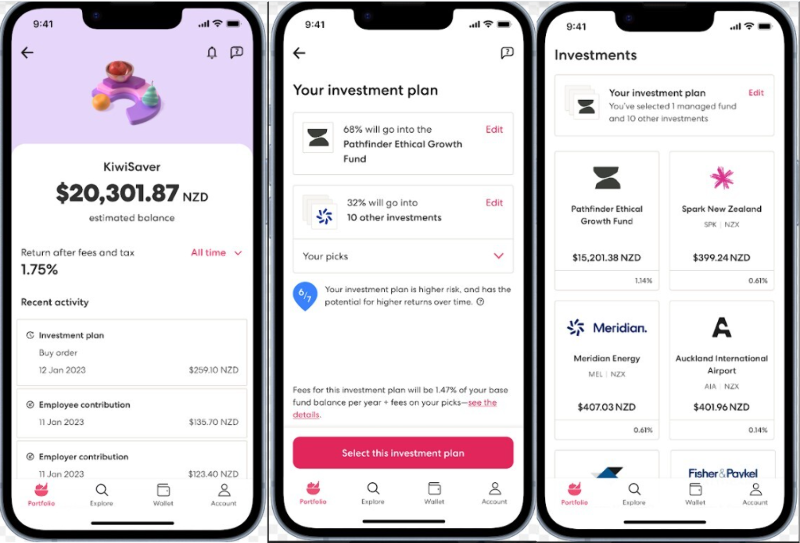
                  Portfolio displayed is a guide, not from a real customer. For informational purposes only

From the pilot group, Sharesies KiwiSaver now has $66 million in funds under management with an average age of 36 and an average balance of $27,000; around the same as the average balance across all providers.

In May Sharesies got regulatory approval to extend the scheme to allow members to invest up to half their KiwiSaver portfolio in individual company shares and ETFs, ranging from 0.1% to 5% per selection. This is the first time this self-select feature has been available.

Sharesies head of KiwiSaver Matt Macpherson says there are currently 93 NZX-listed options available including the most popular ETF on the Sharesies platform- Smartshares’ US 500.

He says US share markets will be added around mid-next year and the ASX after that. He thinks eventually there will be around 500 stocks and ETFs available for self-selection.

Investment builder tool

Sharesies used its own technology to the scheme including an investment builder tool on its website to guide prospective customers in self-select investment planning.

Once investments are selected, the tool calculates the plan’s risk from 1-7 (high risk) to show how much the combined value of the base fund and any shares and/or ETFs, might fluctuate, over time.

It also estimates fees the investor could expect to pay over the first year.

Members can change their investment plan whenever they like—such as when their risk profile, goals, or values change. Sharesies recalculates the risk level and even when customers don’t change their plan, Sharesies will update it each month using the latest data.

More education

Sharesies has ramped up the amount of education and information with information on performance and fees and education flows built into most web pages and the app’s screens.

Macpherson says feedback from the pilot has always been that customers wanted more information and control over how and where they invest.

“When we were doing our research before we got started on the build, a lot of people were telling us they wanted us to demystify certain aspects of the scheme or they wanted us to go into extra detail,” says Macpherson.

Before members reach the option to self-select they are put through more education including values, risk appetite, fund performance, how to diversify, the volatility profiles of companies versus bonds and a reminder about emotional and understanding emotional biases.

“And then finally if you’re not sure, there’s a message to seek financial advice.”

Sharesies is interested in eventually integrating licensed financial advice into its KiwiSaver scheme, says Macpherson.

“While not immediately, we see the value in having financial advisors being able to support our members."

Sharesies also launched its KiwiSaver-dedicated podcast The Payoff, with the sixth episode covering the Sharesies scheme.

Fees

The fee structure is based on each individual investment plan. Base funds have their own underlying fees, and Sharesies doesn’t charge additional management or administration fees. There are no performance fees or annual member charges and no management fee on self-selected shares and ETFs.

But there is an administration fee of 0.15%, and a transaction fee of 1% for self-select investments up to $1000, plus 0.1% for amounts over $1000 – which is aimed at people transferring in from other KiwiSaver providers.

The KiwiSaver scheme is wrapped in a PIE, regardless of whether it includes individual shares and/or ETFs or not.

Macpherson says Sharesies uses Apex to integrate its KiwiSaver scheme with the Inland Revenue Department and its five base fund providers.

KiwiSaver – is consolidation on the cards?

KiwiSaver has finally hit a speed bump shrinking for the first time to end the September quarter at $96.2 billion. That’s down around $2 billion from June.

This was entirely due to market movements and to be expected, says Morningstar data director of Asia-Pacific Greg Bunkall.

“As a growing product, inflows have overshadowed outflow and market movements but as KiwiSaver matures we can expect market movements to have more impact leading to more ups and downs in the overall KiwiSave balance. It’s normal and to be expected.”

Market maturity means providers need to start thinking about KiwiSaver as a traditional investment product with ups and downs in market movement and no longer in terms of guaranteed revenue growth, he says.

Recently there has been a significant increase in options and providers particularly with white label funds brought onto platforms such as InvestNow and KiwiWRAP and offered as KiwiSaver.

Bunkall until this point, New Zealand hadn't had the same level of proliferation as Australia, but the trend there is reversing with the number of super funds falling from 170 to about 120. ”Regulators are really trying to increase the scale at which the super funds operate. Australia Super, for instance, is a A$263 billion fund in assets and it anticipates to be at A$500bn at 2026. QSuper and SunSuper, which were about the same size were put together and are about the same size as AustraliaSuper with similar growth aspirations.”
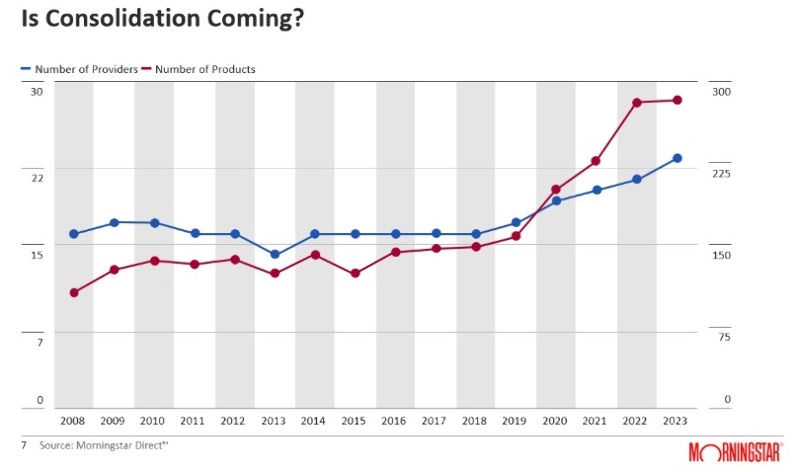
Bunkall says Morningstar anticipates increased scale, heightened competition, larger member balances, passive investment strategies and regulatory pressures.

Drawing insights from what we can see overseas we would expect these trends to persist and continue downward pressure on fees.

Fees reduced but expensive funds grow

In KiwiSaver multi sector categories, about $310 million worth of fees were generated in 2016, more than doubling in the last six years to around $645m.

While the industry has experienced great revenue growth, the average fee paid by members per dollar has decreased by about 9%. In 2016, this was about 87 basis points which has been reduced to 80. But that 9% decrease has been masked by investors moving into more expensive funds i.e., from conservative to growth products generally.

In 2016, conservative and moderate categories, which are cheaper, accounted for about 45% of assets under management and now make up only 27%, says Bunkall. “Investors have preferred to shift more recently into growthier, more expensive,

KiwiSaver options. That has meant a lot of the fee deductions in those more expensive categories have been negated. If we actually look into it, the average balanced category has gone down by 16% and the average growth has gone down by 22%.”

Asset allocation

Investors are starting to take note, checking their risk profile and moving towards growth funds. In 2011 overall asset allocation was 60% income and 40% growth. This is now more like 45% income and 55% growth.

This shift is not uniform across providers, though. Analysis of the banks, Milford and Fisher Funds revealed some quite varying splits with one of the most conservative providers members split 50/50, while one of the most aggressive providers coming in at 61/39 towards growth.

“A provider with 50/50 is going to have a lot of headwinds trying to generate market share compared to one focused on market progression,” says Bunkall.

Exposure to international equity ranges from 30% to 50%, NZ equities from 9%-18% and alternatives from 0%-9%.

For the September quarter the five largest KiwiSaver providers accounted for approximately 68% of assets and fees but the landscape is changing. ANZ led the market share with more than $18.8 billion followed by Fisher (15.5%) which knocked ASB back to third place. BT (Westpac) dropped to the fourth spot ahead of Milford, which debuted in the top five.

Almost all multisector KiwiSaver funds produced negative returns over the September quarter. Average returns from the multisector category after fees and before tax ranged from -1% for conservative funds to -3.1% for the aggressive category. Among the defaults, SuperLife did best, losing the least.

Over 10 years, the average annual return for aggressive funds was 8.0%, followed by growth (7.6%), balanced (6.1%), moderate (4.3%), and conservative (3.9%).

Over longer periods, Quay Street, Milford and Generate continued to perform well across the categories in most periods.
KiwiWrap KiwiSaver has highest average balance

With an average balance of more than $120,000, KiwiWrap is way ahead of other KiwiSaver providers, although it has under 300 members.

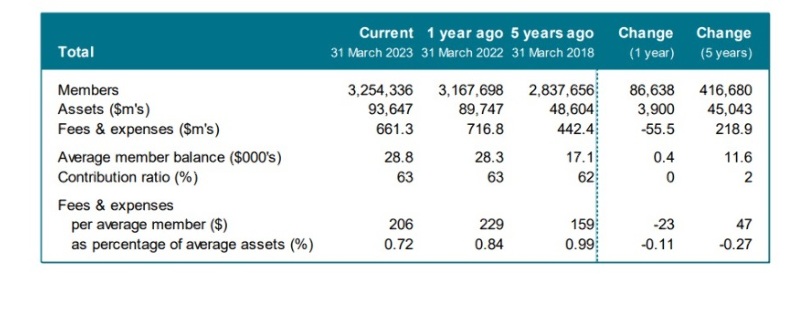
Melville Jessup Weaver’s KiwiSaver market review for the year to March 2023 revealed the top ten providers for average balance size, with only one major bank making the leaderboard.

The Consilium-owned KiwiWrap KiwiSaver Scheme is a self-select scheme designed for investors wanting customisable investment choices. It focuses on making sure its members benefit from financial advice through advisers who can monitor and report on clients’ portfolios through Consilium Wrap (FNZ). They and investors have access to more than 400 investment options, including international shares, ETFs and bonds.

From KiwiWrap’s $120,000 it was quite a drop to the next three biggest balances on average; MAS at around $70,000 followed closely by Craigs and Milford. Coming in at just below $60,000 were Maritimes, newcomer Sharesies (with just 16 members at the period covered by the report) and Summer. They were followed by ANZ’s OneAnswer, Select and InvestNow all hovering above $50,000.

The bottom five (all around the national average of $27,000) were Booster, Aurora, BCF (Brethren Christian Fellowship), the Muslim targeted AE (Always Ethical) and BNZ.

The report looked at the highest and lowest contribution ratio. Sharesies and KiwWRAP led but because of their low membership numbers were not that informative but the next three NZDF, Maritime and Supereasy (at 80% or just above contribution rates), which the report said, may reflect good engagement with restricted membership pools. Aurora, Kernel, Kōura, Pathfinder and BCF all had high engagement rates of just below 80%.

Changes bubbling from below

On other key statistics, rankings by member numbers were fairly static with ANZ at the top, followed by ASB, Westpac, KiwiWealth (now part of Fisher Funds) and BNZ . However, five schemes managed to grow their member base by more than 10,000 people, with Simplicity adding more than 15,000.

For assets under management in a single fund, ASB KiwiSaver Scheme overtook ANZ to reclaim the title of largest single scheme (almost $14.5 billion with $464m added).

Otherwise, the ordering of the top ten schemes did not change ASB, ANZ, Westpac, BNZ and AMP. In terms of asset growth, Milford stood out with a gain of $832m, significantly reducing the gap to AMP in fifth place.

Fisher Two added $681m, although this mostly reflects the transfer in from the Aon scheme which was closed over the year. Generate, the aforementioned ASB, and BNZ round out the top five in terms of growth. Several smaller providers have seen strong growth relative to their asset base. Aurora and Kōura more than doubled in size, while InvestNow was just shy of this mark. In its first five months, Kernel gathered $43m.

Once accounting for consolidated ownership, competitiveness measures weakened this year, bucking the trend seen since 2015. The purchase of Kiwi Wealth by Fisher was the main driver.

In aggregate, Fisher Funds accounted for $14.4b, having taken over the Kiwi Wealth KiwiSaver Scheme which had $6.7b under management as of March 2023. This saw Fisher Funds group reach a comparable size to ASB ($14.5b). ANZ group ($18.7 billion) remains the largest KiwiSaver participant.

Once accounting for consolidated ownership, competitiveness measures weakened this year, bucking the trend seen since 2015. The purchase of Kiwi Wealth by Fisher was the main driver, the report said.