All numbers point north for KiwiSaver

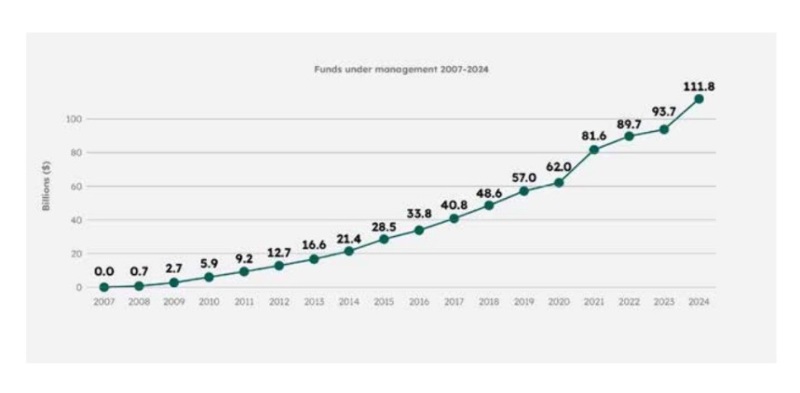
The March 2024 reporting year for KiwiSaver showed the strongest growth in total funds since 2021 and passed the $100 billion milestone, according to the Financial Markets Authority.

The FMA’s annual KiwiSaver report says due to compound returns and fund selection, the next $200b will arrive a lot sooner than the first.

There are now 3.3 million people invested in KiwiSaver, about 62% of the total population. Of those, almost three million have selected their own provider and fund.

Ending the financial year at $111.8b, there was a 19.3% increase from last year's $93.6b funds under management with a mean balance of $33,514 per member, up 16.5%.

The year’s growth was due to a combination of strong investment returns of $13.1b up from $1.9b loss, and inflows of $11.2b (up 6.5%)  into KiwiSaver through contributions of members, their employers and the government.

FMA director of markets, investors and reporting John Horner said it was pleasing to see individual contributions through salaries and wages were up to an all-time peak of $5.9b this year.

Members withdrew $5b, an increase of 18.8%, including $3b by those over 65 (up 6.4%), $1.2b for first homes and $264.3m(up 82.4%) due to financial hardship. Almost 30,000 members made significant hardship withdrawals, an increase of 60% from 18, 291 last year. However the report said this still represents less than 1% of all KiwiSaver members.

People 65 years or older continued to be responsible for a large majority of withdrawals by value, up 6.4% from last year to $3 billion.

Fees

A gradual decrease in fees as a percentage of funds under management over the last 10 years, wasn’t continued in the 2024 data. Total fees charged by KiwiSaver providers increased, 18.9% – from $664.1m to $789.6m. This was in line with the increase in total FUM and showed fees hadn’t increased or decreased per dollar.

The increase was mainly driven by investment management fees, up 13.1% to $708m and a steep rise in ‘other scheme expenses’ up from $15m to $58m. Admin fees saw a slight rise of 3.3%. Total default fund fees were $13.1m, while total active fees were $776.6m.

KiwiSaver member behaviour changing

Over the last four years the overall investment profile of KiwiSaver has skewed toward growth, driven by more investors making active choices that are in line with their long-term retirement goals.Growth funds represented 46% of total funds under management, with $51.4b  invested, and a total of 1.53 million investors selecting a growth fund. This has grown rapidly over recent years, more than doubling from $24.5 billion in 2021.

Horner says compared with previous years, investor behaviour has changed over time, together with the profile of the funds being selected. With KiwiSaver in its 17th year, investors have become more comfortable with the long-term nature of KiwiSaver.

“We believe this is why almost half of all KiwiSavers have moved towards more growth-oriented funds.”

Funds labelled socially responsible increased  to $1.4b, more than 30% year on year. The number of people choosing values based funds grew slightly from 45,495 to 47,754.
Switching down

The year to March 2024 saw a further decrease in total switching activity, down to approximately 300,000, an 18% decrease from last year. The total amount of money that moved between funds, but stayed with the same provider, was $6.0 billion, up slightly from last year. The largest number of switches this year involved growth funds, with 130,372 totalling $2.2 billion out, and 116,232 totalling $2.7 billion in.

Sharesies KiwiSaver adds multiple-base fund selection

Sharesies KiwiSaver members can now combine multiple base funds instead of having to choose only one for their KiwiSaver scheme.

When Sharesies launched its self-select KiwiSaver scheme last November, members had to choose between one of five base fund options, ranging from conservative to high
growth, and could also invest up to half their portfolio in individual company shares and ETFs. This year Milford Aggressive Fund was added and there are plans to add more, says Sharesies head of Kiwisaver Matt Macpherson.

Now customers can invest as much or as little as they like of their KiwiSaver portfolio in each base—provided they total at least 50% of their investment plan,

“It’s important we make it possible to spread contributions across multiple base funds. We’ve had lots of requests for this and we’re prioritising the features that are important to our members.”

Virtually no-one is going to say they want all six, says Machpherson who envisages customers choosing two or three. “But they may want a bit of Milford and a bit of Pathfinder. It enables more personalisation. Our whole thing is about control.”

In support, Sharesies has also upgraded its investment plan builder tool on its website. This enables a draft investment plan to be created which allows members, or those considering joining the scheme, to view the overall make-up of their portfolio, including their personalised risk score and fee estimate. The plan can be saved and revisited.

Once changes are made, members can keep track of how their KiwiSaver investments are performing in the Sharesies app which offers details such as price history, returns, fees and holdings.

“When you combine two base funds you will have a weighted average around fees. We’ve also brought in underlying ETF charges and we will be adding more over time.”

Sharesies is looking at adding other base funds, such as single sector and there will definitely be US self-select options, says Macpherson.

Of Sharesies’ 8000 KiwiSaver members, about 40% have opted to self-select covering about 10% of contributions.

Macpherson says at $110b funds under management, total KiwiSaver funds are destined to keep growing and there needs to be innovation to support this growth.

“We see so much potential, not just as a KiwiSaver offering, but this is a wealth creation opportunity for the country.”

With a membership that skews younger, the average balance is just under $30,000 across the scheme, says Macpherson.

He says Sharesies is definitely interested in partnering advisers. “We spent several months earlier this year doing some research to find out what the best member and adviser experience would be.

“We have quite a big feature roadmap and you will be likely to see us enter the adviser business next year.”

Overall Sharesies, has more than 650,000 investors across New Zealand and Australia and more than $3b in funds under management.

Two KiwiSaver schemes report larger losses but make revenue gains

Two of the newer KiwiSaver schemes chalked up larger losses in their latest financial year.

But while Sharesies KiwiSaver scheme had about 5,000 members at March 31, it has since reached about 8,000 members and needs about another 5,000 to join to allow it to break even, according to Sharesies co-founder and chief executive Leighton Roberts.

Roberts says his company only went public with its KiwiSaver offer in December last year, suggesting momentum towards break even is on its side.

The KiwiSaver vehicle, Sharesies Investment Management, reported a net loss of just over $1 million for the year ended March, up from the previous year's $331,000 loss, according to accounts published with the Companies Office.

While the accounts show net equity at balance date of $123,000, suggesting the company will need more capital in a hurry, Roberts says the parent company will tip in further equity as needed.

The KiwiSaver company's revenue climbed from just $1,000 in the year ended March 2023 to $534,00 in the year ended March this year.

Sharesies currently has about 700,000 members using its share trading platform, up from nearly 600,000 this time last year, providing it with an audience for its KiwiSaver offering.

Koura Wealth, which allows its KiwiSaver investors to choose between nine different funds, one of which is a bitcoin-based fund, filed accounts with the Companies Office showing it lost $1.7 million in the year ended March, up from the near $1.5 million net loss the previous year.

The accounts show its equity holders contributed another $1.2 million during the latest year, bringing their total contributions to $6.1 million.

After accumulated losses of just over $6 million, Koura Wealth had equity of $107,000 at March 31.

But it does appear Koura is making progress, with revenue rising to $655,000 in the latest year from $305,000 the previous year.

The accounts note that Koura has a related-party relationship with Hobson Wealth, which stock broking firm Forsyth Barr bought late last year for an undisclosed sum.

Hobson Wealth former principal Warren Couillaut's Audrey Investments owns 14.8% of Koura, according to Companies Office records.

Hobson provided Koura with brokerage, execution and accounting services during the year and Koura was also a sub-tenant of a property owned by Hobson.

The accounts show key management personel were paid $378,000 in the year ended March, up from $268,000 the previous year.

ASB CEO talks compulsion, contribution and PE in KiwiSaver

ASB CEO Vittoria Shortt would like to see change when it comes to KiwiSaver policy and is interested in developing the product.

Shortt says she’s very happy with the scheme and the bank's strategic partnership with Blackrock as underlying asset manager has yielded pleasing results which will be evident when it puts out its investing climate report.

This year ASB KiwiSaver members have made $1.7 billion in contributions and investment returns have seen the fund grow by $1.5b, she says.

On the policy front she would like to see KiwiSaver made compulsory and changes to contribution rates. She says both of these have made a massive impact in Australia and I think New Zealand could do the same.

From a provider perspective, it will be interesting to see what different investment categories will open up at scale, as in Australia.

“We want to make sure KiwiSaver conversations are as simple and easy as possible so we are removing barriers from people thinking about saving for their future, because it's not easy… it's not always front of mind for people.

“When they want a home, people are really clear that they want a home. But trying to convince people to think about their retirement when they're 20 is more challenging.”

Hence ASB is focused on helping people make small, everyday steps with their KiwiSaver. 

As for private equity allocation in KiwiSaver, she is interested although it’s not something ASB has executed so far.

“I am genuinely interested in the development of KiwiSaver. And I guess, you just have to look across to Australia to see the ways that the big super funds are participating there. I'm interested in understanding what it takes to, in an appropriate way, participate in supporting the country, so yes although we haven’t done anything specific.”

Currently ASB is neck and neck with Fisher Funds in the battle for KiwiSaver market share. Morningstar’s KiwiSaver report for the second quarter of this year put ASB in third place, just behind Fisher, both with 15.1% of the market and assets of $16.8b each.

Fisher outdid ASB for fee revenue with $160.1m compared to ASB’s $100.3m.