Gender pay gap and not contribution rates disadvantage women on KiwiSaver

Research by Auckland University of Technology for the Retirement Commission points to the gender pay gap as the main cause for women contributing less.

AUT used Stats NZ’s new integrated data infrastructure (IDI), which covers KiwiSaver contribution rates from April 2019, for its analysis. The Retirement Commission says the new research complements a 2022 study it commissioned from Melville Jessup Weaver.

While the latter looked at KiwiSaver balances across a range of demographics, the new research examines contribution rates across different demographic groups.

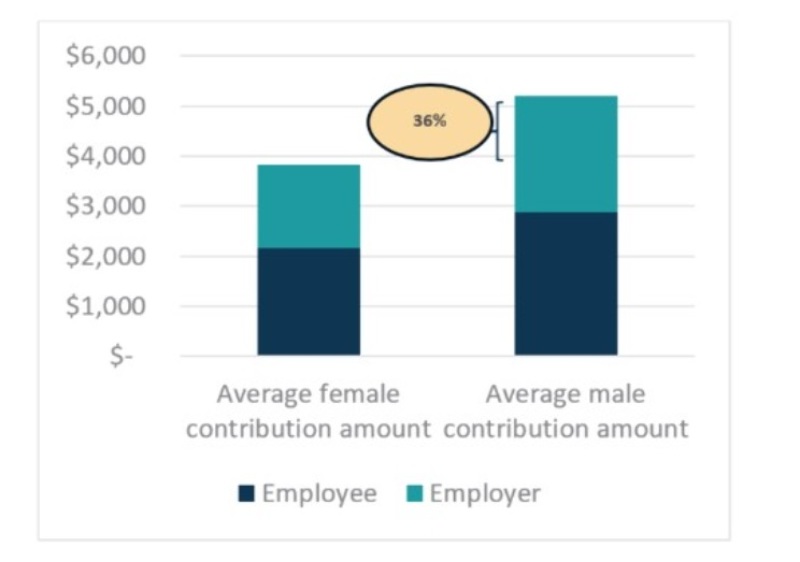
Despite women contributing to KiwiSaver at about the same rate as men, women are putting away 36% less per year.
The data shows a very high percentage of paid employees (arguably the main target of the scheme under its current settings) are contributing, with only a small number on savings suspensions at any one time, and most savings suspensions lasting less than a year.

Men spend more time on savings suspensions than women (5.6 months compared to 5.2 months). For women non-contributing months are more likely due to periods out of paid work compared to men.

Message to employers

Retirement commissioner Jane Wrightson wants employers to look at their KiwiSaver policies and ask “whether they have their employees’ best interests at heart.”

The research also found that one in three employees contribute at a rate higher than the 3% minimum but less than 10% of employers do the same.

And instead of paying KiwiSaver contributions on top of an employee's earnings, almost half of employers include them in total earnings for at least some of their employees, 25% use the same approach for all employees, and 20% for some of their employees.

The use of a total remuneration approach by employers in the study didn’t appear to be influenced by organisational type such as the size, age of firm, or whether it is private or private, a policy brief by the commission says.

It goes on to say this is not how KiwiSaver is designed to operate but is not legislatively prohibited so long as the outcome is the result of good faith bargaining.

The removal of the incentive of having the employer contribution on top of salary or wages could also be one explanation for periods of non-contribution (savings suspensions) by people in paid work but further research asking people why they took a savings suspension would be needed to find out whether this is the cause.

“If we want to see change, I think we need to see a more proactive attitude across the board from employers. We all have a stake in New Zealand’s future and there are concerns that people may not be saving enough for retirement, so we need to be taking practical steps to tackle these issues.”

Retirement Commission policy lead, Dr Michelle Reyers, says new data presents an opportunity to look deeper into the forces causing contribution amounts to differ so significantly across gender and ethnicity.

“The data allows us to examine the individual characteristics of KiwiSaver members in a way we’ve never been able to before. It exposes some clear imbalances which tell us that if we don’t make changes, we are on a pathway to continue seeing the inequalities we are already seeing in our retired population for decades to come,” she says.

According to Stats NZ, the gender pay gap was 9% in 2021, and larger for Māori and Pacific women.

Women are also more likely to work part time and take on unpaid caring responsibilities, further exacerbating this gap, which is why we are seeing the larger difference in the dollar value of contributions into women’s accounts compared to men’s accounts in this research.

The research shows ethnic pay gaps are also mirrored in lower KiwiSaver contribution amounts for Māori and Pacific Peoples. If you are Māori or Pacific, you are likely to have around $1,500 less contributed into your KiwiSaver account annually than a European person.

However, Māori have the second highest average employee contribution rate of the ethnic groups reported in this research, despite having the lowest average income.

The data highlights the sizable impact of ethnic and gender pay gaps on New Zealanders’ abilities to prepare adequately for retirement. It is already known that Māori, Pacific Peoples and women are more likely to be reliant on NZ Super in retirement due to lower savings and investments.
Bayly will talk to coalition partners before any change to KiwiSaver

Minister of Commerce and Consumer Affairs Andrew Bayly says he wants to focus on capital markets and KiwiSaver providers have a part to play.

“The thing about KiwiSaver and capital markets in general is how do we get more capital coming into businesses, how do we make sure financing around debt is appropriate?”

He wants to make it easier for providers to invest in New Zealand business, but says there is also an issue around the settings of KiwiSaver itself.

He plans to look at it later this year and doesn't anticipate difficulty in doing so.

“No, I don’t think so. I’ve started having those conversations but part of that is working with my coalition partners. We’re in a coalition government and we need to make sure we’ve got the right settings. I think there are areas we could look at improving.”

Act KiwiSaver policies pre-election

In an alternative budget put forward by Act leader David Seymour while campaigning last year, KiwiSaver subsidies would become targeted. Members would be eligible for a subsidy of up to $521.43 capped at 5% of a participant’s taxable income. The maximum subsidy amount would reduce by 3% per dollar of income above $48,000, reducing to zero by around $65,000.

Act policy is to gradually increase the age of eligibility for superannuation but it would de-link the KiwiSaver withdrawal age from superannuation age and keep it at 65.

NZ First KiwiSaver announcements

Among New Zealand First’s 2023 election planks it announced that at a certain balance, it would give KiwiSaver members full access to their savings to downsize their mortgage. It said this was based on the Singaporean model.

Other KiwiSaver related initiatives included that it would: make KiwiSaver membership compulsory from the age of 18 after commencing employment; restore the kickstart with auto-enrolment at birth from 1 July 2024, encourage all under 18 year olds to get into KiwiSaver by offering an annual state contribution of $250, if $250 has been saved in the preceding year up until the 18th birthday; and to support the growth of KiwiSaver funds review fees and increase the government contribution in line inflation since 2007 (48%) to a current maximum of $1540.

It would also maximise returns by “repealing woke KiwiSaver default investment rules that stop investment into any lawful sector while ensuring the NZ Superfund is similarly unencumbered.”

National policy pre-election

The National party announced it would allow KiwiSaver members to split their balance across multiple providers.

Bayly says this was aimed at those with higher balances, a minimum of $100,000 and more likely between $300-400,000.

“I know there are a number of operators offering that type of scheme but people may want to change managers because you might be great in terms of investing in Europe but over here these guys invest in doing clean energy type investments and they’re the best managers of that. So that would give flexibility.”

He says he’s not sure about the party’s other pre-election promise to allow students to dip into their KiwiSaver to pay for tenancy bond deposits.

“That’s something we’d need to test with our coalition partners.

He says the big issue is people are simply not contributing enough into KiwiSaver. “

Would he increase contribution rates each year as the Australian government has done?

“That’s all up for discussion, I haven’t engaged yet with coalition partners.”

Right now his focus is the CCCFA reforms, the insurance contracts bill before the house, the customer data rights bill which is part of laying open banking, and he wants to reform the Companies Act.

“Later this year when I get through all that, when most of that work stream is completed or near completed, is to focus on capital markets.

Simplicity takes stake in tax tech company

Simplicity’s latest private equity investment is an 18.8% share in the parent company of two tax technology companies, Tax Traders and its startup business Taxi.

The investment will primarily be used to develop Taxi, a new company offering access to working capital for businesses, backed by their provisional tax payments.

Tax Traders, which started in 2012, is a tax pooling intermediary that works with accountants to give taxpayers more flexibility when paying provisional tax.

It is investing into its next venture – Taxi, which uses the same provisional tax framework to provide business funding.

Co-founders Josh Taylor and Nicola Taylor say securing capital to invest in Taxi is a critical part of scaling quickly.

“Taxi has the potential to have a huge impact for Kiwi businesses and New Zealand’s GDP, and we knew that securing an investment partner would mean we could scale quickly and see many more businesses benefitting faster,” says Nicola Taylor.

“We were very clear that we wanted a partner who shared a vision for this country and was interested in sustainable business results, rather than an investor who was solely focused on a short-term financial return.

“We are in business because we believe business can be a force for good and this requires a different approach to capital investment. In Simplicity, we found an investor whose values align with ours and who we knew would encourage us to make sustainable business decisions, in line with our DNA, not purely with a financial outcome,” she says.

Simplicity’s passive equity provides the company with another funding option instead of taking on debt or selling a major equity stake, says managing director Sam Stubbs.

The KiwiSaver provider’s private equity strategy is to take minority and passive equity stakes in unlisted Kiwi companies across different industries and remain for the long term. The preferred private equity investment is between $5-10 million to support established small-to-mid size private enterprises.

The new investment marks Simplicity’s sixth private equity investment. Others are Icehouse Ventures, Quantifi Photonics, Reliable Foundations, Pure Food Co and DataTorque.

Kiwis, depending on their age group, generally want compulsory KiwiSaver

Most Kiwis, bar Millennials, think regular KiwiSaver contributions should be compulsory, a survey has found.

When Auckland financial advice firm National Capital canvassed New Zealanders on whether they felt KiwiSaver contributions should be compulsory, nearly two thirds, 62%, of the 672 respondents said, yes.

Those closer to retirement age were the most likely to answer yes, with 79% aged 65 and over and 71% aged 60-64 in agreement. At the other end of the demographic scale, 68% of Gen Z aged 18 to 27, also agreed.

Millennials or 28-43 year olds were the exception, with only 48% supporting compulsory contributions. Reasons given were maintaining personal choice and autonomy, and affordability/cost of living pressures, and opposing mandatory participation in the scheme.

The survey also found most respondents (74%) plan to use their KiwiSaver for either living expenses in retirement or paying off their mortgage.

National Capital founder and co-director Clive Fernandes said while the younger generation has been educated more about the importance of finance and savings, and older generations are close to retirement, Millennials have the most expenses and still see retirement as being a long way off.

Cost of non-contribution

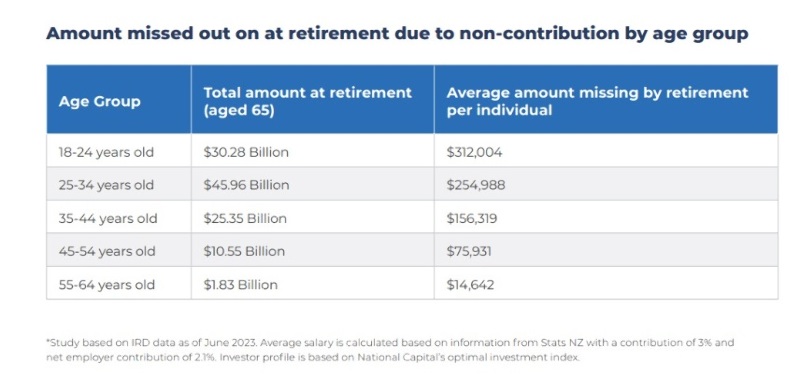
Using data from IRD, MBIE and Stats NZ, National Capital says if the 703,325 non-contributing KiwiSaver members contributed the 3% minimum, the collective amount they could get at retirement was approximately $113 billion. The demographic most at risk of significant losses was those aged 18-24, each potentially missing out on an average of more than $300,000.

The findings were part of National Capital’s fourth KiwiSaver Value for Money Report which rates diversified KiwiSaver funds against six pillars; performance after fees, assessment of the value provided for fees, fund management capability, provider stability, portfolio composition and processes, and ethical investing.

The report found the amount of wages Kiwis contributed to their KiwiSaver in the last quarter of 2023 fell 0.03% on Q3 giving an overall contribution of 4.27%, well below National Capital’s recommended optimum of 6.3%.

Fernandes says the cost of living may be having an impact and it doesn’t bode well for Kiwi’s retirement prospects.

The report also looked at how KiwiSaver members are invested with an asset allocation index in which higher the index, the higher growth allocation.

After edging up three points in the March quarter to 59, the allocation index remained consistent in the last two quarters with a negligible increase to 59.6. However this too falls short of the optimal of 68.8%.

For the last quarter this was 56 compared to an optimal rating of 68.8. The gap represents a potential $48 billion in lost earnings and Kiwis are not investing their money in the best way for their life stage.

Ratings

For high growth funds, Booster Socially Responsible High Growth followed by FANZ Lifestages High Growth, Booster High Growth, Generate Focused Growth and Milford Aggressive were all rated A across the pillars.

All A-rated high growth funds were New Zealand owned. Booster’s Socially Responsible High Growth Fund maintained its leading rating from the last quarter with an improved 5 year annualised return of 11% per annum over the previous five years.

Last year FANZ Lifestages KS HG had the highest return of 19.7%. The average one year return as of December 2023 for all high growth funds was 15. 19%. The gap between the worst and best performing funds, based on five year performance, grew to 4.66% as of the quarter.

A-rated growth funds were Simplicity Growth, Fisher Two Growth, Milford Active Growth, Pie Growth and Booster Growth. Simplicity remains the only passive manager to rank among the A-rated growth funds. Pie’s growth fund debuted onto the  A list, while Generate and Fisher Funds fell off. Milford Active remained the top performing fund for the past five years, with an annualised return of 10.55% per annum. 

Across all categories, the performance gap between worst and best performing over a five year period, rose to 5.83% in Q4, from 5.28% for Q3 last year.

Average fees varied greatly across the different categories. High growth had the highest average fees of 1.12%, while conservative had the lowest at 0.61%. The Milford Cash Fund had fees of 0.20%, making it the lowest fee KiwiSaver fund.

While a growing number of providers have been phasing out fixed monthly membership fees, 12 of the 24 KiwiSaver providers researched still mentioned charging membership fees in their product disclosure statements.